Published by Allstream Insiders
Allstream Insiders Summary
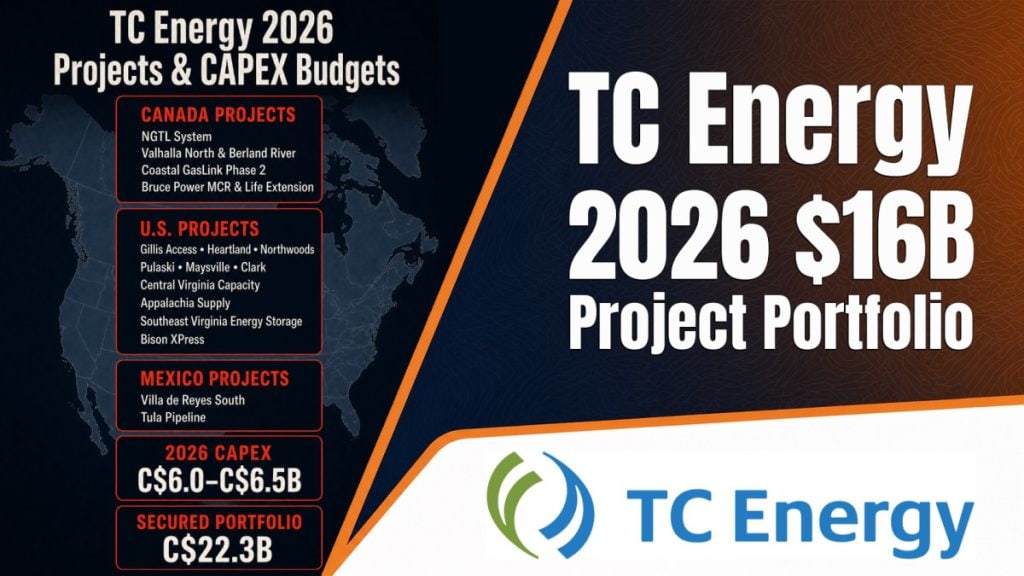
TC Energy reported a C$22.3 billion secured capital portfolio across its Canadian, U.S. and Mexico natural gas pipeline businesses and its Power and Energy Solutions segment. The portfolio includes commercially supported growth projects and three years of maintenance capital.
The company expects C$6.0 billion to C$6.5 billion of capital expenditures in 2026. Net capital expenditures are expected to range from C$5.5 billion to C$6.0 billion after adjusting for amounts attributable to non-controlling interests.
During the second quarter, TC Energy sanctioned approximately C$0.7 billion of additional growth projects. The approvals included the Central Virginia Capacity project, a US$0.3 billion Columbia Gas expansion designed to support new gas-fired generation associated with data-center development; the US$0.1 billion Clark project on Columbia Gulf; and approximately C$0.1 billion of additional NGTL System facilities under the Multi-Year Growth Plan.
TC Energy reported C$2.430 billion of capital spending during the first six months of 2026. U.S. Natural Gas Pipelines accounted for C$1.260 billion, or approximately 51.9%, of that amount. Power and Energy Solutions accounted for another C$502 million, primarily through equity contributions supporting Bruce Power.
The first-half total included capital expenditures, project-development spending and contributions to equity investments. It should not be interpreted as a full-year allocation of TC Energy’s 2026 capital outlook among its business units.
TC Energy’s second-quarter release and quarterly report do not provide a forward 2026 operating-expense budget by business unit. The company’s disclosed maintenance-capital programs represent capital investments and should not be categorized as operating expenses.
How TC Energy Organizes Its Business
TC Energy reports four operating business segments relevant to infrastructure contractors, equipment suppliers and project developers:
- Canadian Natural Gas Pipelines: Includes the NGTL System, Canadian Mainline and other Canadian pipeline interests, including TC Energy’s interest in Coastal GasLink.
- U.S. Natural Gas Pipelines: Includes interstate systems such as Columbia Gas, Columbia Gulf, ANR, Great Lakes, Northern Border and Bison.
- Mexico Natural Gas Pipelines: Includes operating and development-stage systems such as Southeast Gateway, Tamazunchale, Villa de Reyes and Tula.
- Power and Energy Solutions: Includes Bruce Power, other power-generation assets and energy-storage activities.
Corporate costs and capital are reported separately but do not constitute an operating business segment.
TC Energy completed the separation of its liquids-pipeline business into South Bow in October 2024. Liquids pipelines are therefore no longer part of TC Energy’s continuing operating portfolio.
TC Energy’s 2026 Capital Program
TC Energy’s full-year outlook calls for C$6.0 billion to C$6.5 billion of capital expenditures before adjustments for non-controlling interests.
The company expects net capital expenditures of C$5.5 billion to C$6.0 billion after accounting for amounts attributable to non-controlling interests.
Through June 30, 2026, TC Energy reported C$2.430 billion of capital spending. The total consisted of:
- C$1.959 billion of capital expenditures
- C$9 million of project-development spending
- C$462 million of contributions to equity investments
First-Half 2026 Capital Spending
| TC Energy Reporting Unit | First-Half 2026 Capital Spending | Share of First-Half Spending | Primary Disclosed Activity |
|---|---|---|---|
| Canadian Natural Gas Pipelines | C$606 million | 24.9% | NGTL expansion and maintenance programs |
| U.S. Natural Gas Pipelines | C$1.260 billion | 51.9% | Growth and maintenance work across the U.S. gas-pipeline footprint |
| Mexico Natural Gas Pipelines | C$51 million | 2.1% | Mexico pipeline systems |
| Power and Energy Solutions | C$502 million | 20.7% | Primarily equity contributions supporting Bruce Power |
| Corporate | C$11 million | 0.5% | Corporate capital |
| Total | C$2.430 billion | 100% | Consolidated capital spending |
Percentages were calculated by Allstream Insiders using TC Energy’s reported capital-spending table. Percentages may not total exactly 100% because of rounding.
These figures represent reported first-half spending rather than full-year business-unit budgets. TC Energy provides a consolidated 2026 capital outlook but does not allocate the entire annual range among its four operating segments.
Secured Capital Portfolio Extends Through 2031
TC Energy classifies commercially supported and committed projects that are under construction, in permitting or approaching permitting as secured projects.
The secured portfolio totaled C$22.3 billion as of June 30, 2026. The reported value included a C$4.3 billion foreign-exchange translation impact.
TC Energy reported that approximately C$5.2 billion of project costs had already been incurred against the portfolio.
The secured-project table includes both growth investments and three years of maintenance capital. Unless otherwise noted, reported values are in Canadian dollars.
| Business Unit and Secured Program | Expected In-Service Period | Estimated Project Cost |
|---|---|---|
| Canadian Natural Gas Pipelines — NGTL System projects | 2027 and 2028 or later | C$1.0 billion |
| Canadian regulated maintenance capital | 2026–2028 | C$2.6 billion |
| U.S. — Gillis Access Extension | 2026–2027 | US$0.4 billion |
| U.S. — Heartland project | 2027 | US$0.9 billion |
| U.S. — Northwoods project | 2029 | US$0.9 billion |
| U.S. — Pulaski, Maysville and Clark projects | 2028–2029 | US$0.9 billion |
| U.S. — Central Virginia Capacity | 2028 and 2030 | US$0.3 billion |
| U.S. — Appalachia Supply | 2030 | US$1.5 billion |
| U.S. — Southeast Virginia Energy Storage | 2030 | US$0.3 billion |
| U.S. — Other capital | 2026–2031 | US$1.7 billion |
| U.S. regulated maintenance capital | 2026–2028 | US$2.6 billion |
| Mexico — Villa de Reyes South section | Not established | US$0.4 billion |
| Mexico — Tula pipeline | Not established; subject to future FID | US$0.4 billion based on 2022 contracts and subject to update |
| Bruce Power — Unit 4 Major Component Replacement | 2028 | C$0.9 billion |
| Bruce Power — Unit 5 Major Component Replacement | 2030 | C$1.1 billion |
| Bruce Power — Life-extension program | 2026–2031 | C$1.7 billion |
| Other non-recoverable maintenance capital | 2026–2028 | C$0.4 billion |
The project estimates include 100% of capital expenditures for entities that TC Energy fully consolidates, including partially owned consolidated entities. They also include TC Energy’s equity contributions to non-consolidated investments.
The values should therefore not be interpreted as spending wholly attributable to TC Energy in every case.
New U.S. Pipeline Projects Target Power Demand
TC Energy approved two U.S. natural gas pipeline expansions in June 2026 with a combined estimated cost of US$0.4 billion.
Both projects are supported by 20-year take-or-pay contracts.
Central Virginia Capacity Supports Data-Center Development
The Central Virginia Capacity project is a Columbia Gas expansion designed to provide up to 0.4 Bcf/d of natural gas transportation capacity.
The capacity will support new gas-fired generation associated with data-center development.
TC Energy estimates the project will cost approximately US$0.3 billion. It is expected to enter service in phases during 2028 and 2030.
TC Energy did not identify the power-plant owner, data-center operator, specific construction locations, EPC company or contractors in its July 30 materials.
The approval establishes a sanctioned pipeline-capacity program, but it does not represent a publicly disclosed contractor award.
Clark Adds Transportation Capacity for Existing Generation
The Clark project will expand the Columbia Gulf system by up to 0.3 Bcf/d.
The additional capacity will provide firm natural gas transportation service to an existing gas-fired power plant.
TC Energy estimates Clark will cost approximately US$0.1 billion and enter service in 2028.
Clark is also included in TC Energy’s broader US$0.9 billion grouping for the Pulaski, Maysville and Clark projects, which are expected to enter service during 2028 and 2029.
The US$0.1 billion figure is the individual estimate for Clark. The full US$0.9 billion amount covers all three projects and should not be assigned to Clark alone.
TC Energy did not explicitly associate the Clark project with data-center development.
Appalachia Supply Adds a Larger 2030 Expansion
TC Energy approved the Appalachia Supply project in April 2026.
The Columbia Gas expansion is designed to provide up to 0.8 Bcf/d of additional capacity supporting gas-fired power generation.
The project has an estimated cost of US$1.5 billion and a planned 2030 in-service date.
Central Virginia Capacity, Clark and Appalachia Supply collectively demonstrate the role of gas-fired power generation in TC Energy’s incremental pipeline demand.
Of the three projects, only Central Virginia Capacity is explicitly connected to data-center development in TC Energy’s disclosure.
Canadian Pipeline Work Centers on NGTL Growth
The NGTL Multi-Year Growth Plan remains TC Energy’s principal Canadian natural gas expansion program.
TC Energy’s board has authorized the allocation of up to C$3.3 billion for expansion facilities under the plan. Individual facilities remain subject to project-level company approvals and applicable regulatory approvals.
Approximately C$1.2 billion of NGTL expansion facilities has reached final investment decision, with initial in-service dates beginning in 2026.
The distinction between the two values is important. The C$3.3 billion amount represents the maximum authorized allocation framework, while approximately C$1.2 billion represents facilities that have reached FID.
TC Energy has also stated that not every facility contemplated within the C$3.3 billion authorization is expected to be required.
The newly sanctioned second-quarter additions included approximately C$0.1 billion of NGTL expansion facilities expected to enter service in 2028.
TC Energy is also marketing receipt and delivery service representing up to approximately 1.0 Bcf/d of incremental NGTL System capacity.
The identified demand sources include:
- Power generation
- Data-center load
- Industrial development
- LNG markets
- Oilsands activity
Valhalla North and Berland River Add NGTL Capacity
TC Energy completed the Valhalla North and Berland River project at a total capital cost of approximately C$0.5 billion.
The scope included approximately 33 kilometres of pipeline and a non-emitting electric compressor unit.
Together, the facilities add approximately 400 MMcf/d of capacity to the NGTL System.
Valhalla North entered service during the third quarter of 2025. The Berland River compressor became operational on July 14, 2026.
Canadian Mainline Empress Investment Remains Conditional
On the Canadian Mainline, TC Energy has committed up to C$200 million to support incremental capacity at Empress.
The investment remains subject to final investment decision.
Because the commitment is conditional, it should not yet be characterized as a fully sanctioned construction project.
Coastal GasLink Phase 2 Remains a Development Opportunity
The proposed Coastal GasLink Phase 2 Expansion would add pipeline capacity serving the LNG Canada export facility in Kitimat, British Columbia.
Commercial agreements signed in March 2026 established a framework under which LNG Canada would lead construction as execution manager. Coastal GasLink would provide technical advisory services.
The expansion remains subject to final investment decision by LNG Canada and its joint-venture participants, as well as approval by Coastal GasLink Limited Partnership.
TC Energy did not provide a Phase 2 construction budget or project schedule in its second-quarter materials.
TC Energy separately disclosed a C$37 million committed equity contribution for the Coastal GasLink–Cedar Link project within its Canadian secured portfolio.
That amount should not be interpreted as the cost of the proposed Coastal GasLink Phase 2 Expansion.
Bison XPress Enters Service
TC Energy placed the Bison XPress project into service in May 2026.
The Northern Border and Bison system expansion replaced and upgraded facilities, provided Bakken production with additional access to the Cheyenne Hub and added up to approximately 0.3 Bcf/d of transportation capacity.
The project had a total cost of approximately US$0.4 billion, including a US$0.2 billion interest attributable to TC Energy.
Bruce Power Unit 3 Returns to Commercial Operation
Bruce Power Unit 3 became commercially operational on June 12, 2026, following a Major Component Replacement program that began in March 2023.
TC Energy reported approximately C$1.1 billion of equity contributions to the Unit 3 program.
The company said Unit 3 returned to service seven months earlier than the schedule committed to Ontario’s Independent Electricity System Operator.
The next secured Bruce Power programs include:
- Unit 4 Major Component Replacement: C$0.9 billion, with expected completion in 2028
- Unit 5 Major Component Replacement: C$1.1 billion, with expected completion in 2030
- Life-extension program: C$1.7 billion across 2026–2031
The Unit 4 and Unit 5 MCR estimates are net of expected investment tax credits.
TC Energy separately describes the C$1.7 billion life-extension estimate as covering the Asset Management program through 2028, other life-extension projects and an incremental uprate initiative.
What TC Energy Disclosed About OPEX
TC Energy’s second-quarter release and quarterly report do not provide a forward 2026 operating-expense budget allocated among Canadian Natural Gas Pipelines, U.S. Natural Gas Pipelines, Mexico Natural Gas Pipelines and Power and Energy Solutions.
The secured capital portfolio includes:
- C$2.6 billion of Canadian regulated maintenance capital for 2026–2028
- US$2.6 billion of U.S. regulated maintenance capital for 2026–2028
- C$0.4 billion of other non-recoverable maintenance capital for 2026–2028
These figures represent capital expenditures rather than operating expenses.
For contractors and suppliers tracking maintenance opportunities, the distinction is significant.
Maintenance capital may support integrity work, major equipment replacement and discrete system upgrades that qualify for capitalization. Routine labor, operating supplies and other expenses recorded through the income statement are not included in the same budget category.
TC Energy has not provided a forward business-unit OPEX plan in the reviewed second-quarter materials that can be directly compared with its secured maintenance-capital programs.
Allstream Perspective
TC Energy’s reported first-half spending shows the largest concentration of capital activity within U.S. Natural Gas Pipelines, followed by Canadian natural gas infrastructure and Bruce Power.
The company’s newly sanctioned projects also connect several demand themes relevant to the industrial supply chain:
- Gas-fired power generation
- Data-center development
- LNG-linked Western Canadian takeaway
- Industrial growth
- Pipeline integrity and maintenance
- Nuclear life-extension work
The clearest commercial signals are the sanctioned project budgets, transportation capacities and expected in-service windows.
Central Virginia Capacity, Clark, Appalachia Supply, the NGTL Multi-Year Growth Plan, Bruce Power’s refurbishment sequence and the regulated maintenance-capital programs provide defined areas to monitor for future permitting, engineering, equipment, construction and integrity activity.
TC Energy’s disclosure does not identify EPC firms, equipment suppliers, procurement schedules or bid dates for the newly approved projects.
It also does not establish a full-year OPEX budget by operating business unit.
Those details should remain open until TC Energy, regulators, project owners or contractors release additional supporting information.