Allstream Insiders Summary
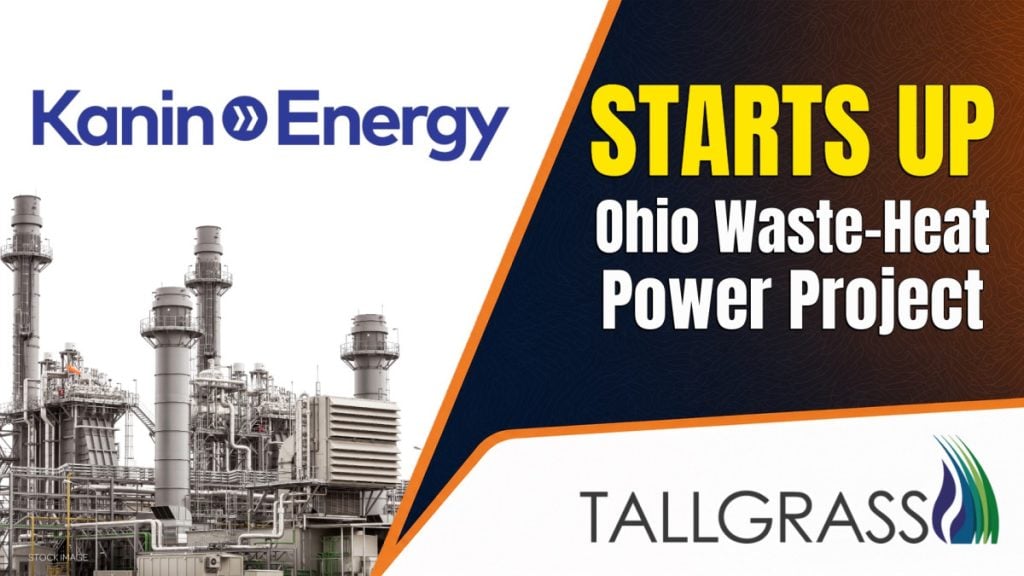
A Tallgrass waste-heat-to-power facility is now supplying electricity for the University of Dayton under a 15-year power purchase agreement involving the university, AES Ohio and Tallgrass. Kanin Energy served as Tallgrass’ development partner for the project, which is connected to an existing natural gas compressor station on the Rockies Express Pipeline near Washington Court House in Fayette County, Ohio.
Tallgrass owns and operates the waste-heat recovery system. The facility captures heat produced during pipeline operations that otherwise would be released unused and converts that recovered energy into electricity. AES Ohio purchases the facility’s output and uses its local distribution system to apply the electricity specifically to the University of Dayton’s electric load.
The parties said the arrangement is expected to consistently satisfy all of the university’s electricity needs. They expect the system to generate approximately 78,000 megawatt-hours annually, predict that it will avoid approximately 55,000 metric tons of carbon dioxide per year, and say it will enable a 71% reduction in the university’s overall carbon footprint. Those figures are forecasts presented by the project participants, not independently verified operating results.
Construction began in October 2024 and was completed in early 2026. Kanin published the startup announcement on July 30, 2026, following announcements issued by the University of Dayton and AES Ohio on July 28.
University of Dayton Waste-Heat Power Project Tracker
| Project item | Disclosed detail | Status |
|---|---|---|
| Location | Existing Rockies Express Pipeline compressor station near Washington Court House in Fayette County, Ohio | Operating |
| Facility owner and operator | Tallgrass | Operating |
| Development partner | Kanin Energy | Development role completed for operating facility |
| Electric utility | AES Ohio purchases the output and applies it to the University of Dayton’s load through its local distribution system | 15-year arrangement in effect |
| University customer | University of Dayton | Receiving project output |
| Construction | Began in October 2024 and was completed in early 2026 | Complete |
| Annual generation | Approximately 78,000 MWh | Expected by the project participants |
| University electricity needs | Project output is intended to consistently satisfy all of the university’s electricity requirements | Company- and university-stated expectation |
| Carbon-dioxide impact | Approximately 55,000 metric tons per year | Predicted by the project participants |
| University carbon footprint | 71% reduction | Expected by the project participants |
How Does the Ohio Waste-Heat-to-Power Project Work?
The facility recovers heat from an operating natural gas compressor station and converts that energy into electricity without requiring the project to produce heat through a separate combustion process. The compressor station is part of the Rockies Express Pipeline system, which crosses Ohio as part of its route between Colorado and Monroe County, Ohio.
The July announcement identifies the installed system as a waste-heat recovery facility but does not specify the generating technology, nameplate capacity, equipment suppliers or engineering and construction contractors. Its disclosed annual output of approximately 78,000 MWh should not be presented as a nameplate capacity because the release does not provide a megawatt rating.
The project operates alongside the existing compressor station. Tallgrass and Kanin said the arrangement demonstrates how energy otherwise lost from industrial operations can be recovered with minimal effect on the host operation.
What Roles Do Tallgrass, Kanin Energy and AES Ohio Have?
Tallgrass owns and operates the generating facility, Kanin Energy served as its development partner, and AES Ohio provides the commercial and distribution connection to the university. Their disclosed roles are:
- Tallgrass: Constructed, owns and operates the waste-heat recovery facility connected to its compressor station.
- Kanin Energy: Worked with Tallgrass as development partner for the waste-heat-to-power project.
- AES Ohio: Purchases the electricity and applies it specifically to the University of Dayton’s load through the utility’s local distribution system.
- University of Dayton: Receives the electricity attributed to the project under the 15-year agreement.
The parties said the project-specific arrangement does not shift its costs to other AES Ohio customers. The release does not disclose the power price, total capital cost, financing terms or financial consideration among the participants.
What Does “Carbon-Free” Mean in This Announcement?
The project participants describe the recovered electricity as carbon-free because the facility uses heat already produced by pipeline operations rather than burning additional fuel to generate power. Allstream is attributing that description to Kanin, Tallgrass, AES Ohio and the University of Dayton.
The announcement does not present a complete lifecycle-emissions analysis for the project or the underlying natural gas pipeline operations. It also treats the predicted annual carbon-dioxide avoidance and the university’s expected carbon-footprint reduction as forward-looking estimates. The 71% figure refers to the University of Dayton’s overall carbon footprint; it does not mean the project eliminates emissions from every university activity.
The project participants also call the initiative “first-of-its-kind.” An earlier AES Ohio announcement described the project more narrowly as the first U.S. waste-heat application of this scale in nearly a decade to provide decarbonized energy at a near match to the customer’s load. The current materials do not establish that waste-heat-to-power generation itself is a new technology.
What Could the Project Mean for Industrial Energy Development?
The operating project provides a commercial example of an industrial host, power developer, regulated utility and end-use customer coordinating a waste-heat recovery system. Kanin and Tallgrass identify natural gas processing, refining, cement, steel and chemical facilities as other industrial settings where similar technology could potentially be applied.
Based only on the configuration disclosed for the Ohio project—not on announced solicitations—future projects of this type could involve:
- Industrial heat-source evaluation and project development
- Waste-heat recovery and power-generation equipment
- Electrical interconnection and distribution-system engineering
- Compressor-station integration and controls
- Power-purchase and customer-load arrangements
- Operations, maintenance and performance monitoring
No new replication project, request for proposals, contractor award or equipment order was announced with the University of Dayton startup. These work areas describe potential requirements for similar developments, not currently available bid packages.
Allstream Perspective
The University of Dayton project is notable because its commercial structure links power recovered at a pipeline compressor station to a specific institutional customer’s electric load through a regulated utility. That structure is as important as the generating equipment: Tallgrass provides the industrial host and owns the facility, Kanin supplies development expertise, AES Ohio purchases and delivers the output, and the university supplies the long-term demand.
The startup also moves the story from a proposed sustainability arrangement to an operating energy project. Construction is complete and power is flowing, while the annual electricity and emissions benefits remain expected performance figures that will be tested through operations.
For the industrial supply chain, the next useful disclosures would be measured operating output, actual availability, verified emissions performance and any additional Tallgrass or Kanin projects using the same model. Those data would help establish how readily the approach can be repeated at other compressor stations and industrial facilities.