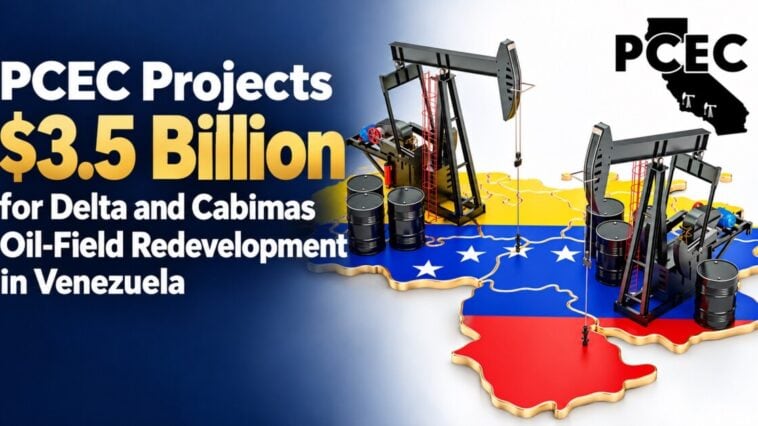

Petroindependencia received development rights for the Carabobo-1 and Carabobo-2-South-A areas as Chevron’s Venezuelan joint ventures outlined more than $7 billion of investment over five years.
Published by Allstream Insiders
Allstream Insiders Summary
Chevron Corporation has expanded its position in Venezuela under agreements that update the terms of its joint ventures and assign additional development acreage in the Orinoco Belt. Chevron says the joint ventures plan to invest more than $7 billion over the next five years and more than double production to approximately 600,000 barrels per day compared with 2026.
Under the agreements, the Petroindependencia, S.A. joint venture received rights to develop the adjacent Carabobo-1 and Carabobo-2-South-A areas. Chevron’s subsidiary holds a 49% interest in Petroindependencia, which is already producing extra-heavy oil in the Orinoco Belt.
The company describes the two additional areas as greenfield sites. The September 2 announcement establishes development rights and a portfolio-level investment plan, but it does not identify final investment decisions, construction-start dates, individual project budgets or contractor awards for the new acreage.
Chevron Venezuela Investment and Acreage Overview
| Item | Company-reported detail |
|---|---|
| Planned investment | More than $7 billion over five years across Chevron’s Venezuelan joint-venture plans |
| Production objective | More than doubling production to approximately 600,000 bpd compared with 2026 |
| New development areas | Carabobo-1 and Carabobo-2-South-A in the Orinoco Belt |
| Assigned joint venture | Petroindependencia, S.A. |
| Chevron interest | Chevron subsidiary holds 49% of Petroindependencia |
| Previously added area | Ayacucho 8, assigned to the Petropiar, S.A. joint venture under an April 2026 agreement |
| Current disclosure stage | Updated joint-venture terms, acreage assignments and portfolio plans announced; no project-level construction authorizations disclosed |
What changed under Chevron’s new Venezuela agreements?
The agreements establish updated fiscal, commercial and legal terms for Chevron’s Venezuelan joint ventures and expand Petroindependencia’s development footprint. Chevron says the revised terms are intended to support future investment, project development and production growth.
Petroindependencia received rights to develop Carabobo-1 and Carabobo-2-South-A, two areas adjacent to its existing operations in the Orinoco Belt. Chevron characterizes the sites as greenfield developments that extend a joint-venture footprint where extra-heavy-oil production is already increasing.
The assignment of development rights is an important commercial and legal milestone, but it does not establish that field construction has begun. Project-specific execution will depend on subsequent technical work, investment decisions and applicable regulatory and commercial requirements.
How does the September expansion build on Chevron’s April agreement?
The September agreements follow an April 2026 asset arrangement that increased Chevron’s working interest in Petroindependencia to 49% and added another Orinoco development area. Under that earlier agreement, Chevron gained an additional 13.21% working interest in Petroindependencia.
The Petropiar, S.A. joint venture, in which a Chevron subsidiary holds a 30% interest, also received rights to develop the adjacent Ayacucho 8 area. The September announcement adds Carabobo-1 and Carabobo-2-South-A to the portfolio through Petroindependencia.
Chevron’s other named Venezuelan joint venture is Petroboscan, S.A., located in Zulia State in western Venezuela. Petroindependencia and Petropiar operate extra-heavy-oil projects in the Orinoco Belt.
What does the $7 billion investment plan cover?
Chevron presents the more-than-$7-billion figure as a five-year investment plan for its Venezuelan joint ventures. It should not be interpreted as Chevron-only capital spending or as the budget for Carabobo-1, Carabobo-2-South-A or Ayacucho 8 individually.
The September announcement does not allocate the total among the three joint ventures or the newly assigned areas. It also does not provide project-level capacity additions, development schedules or annual spending profiles.
The associated production objective is to more than double production to approximately 600,000 bpd compared with 2026. Chevron states the figure in connection with the joint-venture plans and does not label it as Chevron’s net production share. The target is forward-looking and depends on successful project execution and operating conditions.
How do U.S. sanctions rules affect the announced plans?
The announcement follows the U.S. Treasury Department’s August 27 issuance of Venezuela General License 50C, which lists Chevron among the companies authorized to conduct certain transactions related to oil or gas operations in Venezuela. The authorization covers specified transactions that would otherwise be prohibited under the Venezuela Sanctions Regulations, subject to conditions.
General License 50C includes contractual, payment and reporting requirements and excludes certain counterparties and transactions. It does not represent a blanket removal of U.S. sanctions or relieve participants from complying with other federal requirements.
Chevron’s release thanks the U.S. administration, the Department of Energy and Energy Secretary Wright for helping facilitate conditions for investment and growth. The company does not state that the general license, by itself, constitutes every approval that individual development projects may require.
Allstream perspective: the portfolio plan could create a broad development program
The combination of greenfield acreage and a five-year joint-venture investment plan could support a significant extra-heavy-oil development program if individual projects advance. Based on the disclosed asset type and development stage, potential work categories could include:
- Reservoir appraisal, drilling and well-completion services
- Production facilities, gathering systems and pumping equipment
- Diluent handling, flow-assurance and heavy-oil transportation systems
- Produced-water treatment, storage and field utilities
- Electrical systems, instrumentation, controls and automation
- Civil construction, inspection, maintenance and environmental services
These categories are Allstream analysis based on the announced greenfield extra-heavy-oil development rights. They are not announced bid packages, solicitations or contractor awards.
The next commercially meaningful evidence will be project-specific investment decisions, development plans, permitting milestones, contractor selections and procurement notices. Any supplier participation must also comply with the applicable sanctions licenses and other legal requirements.