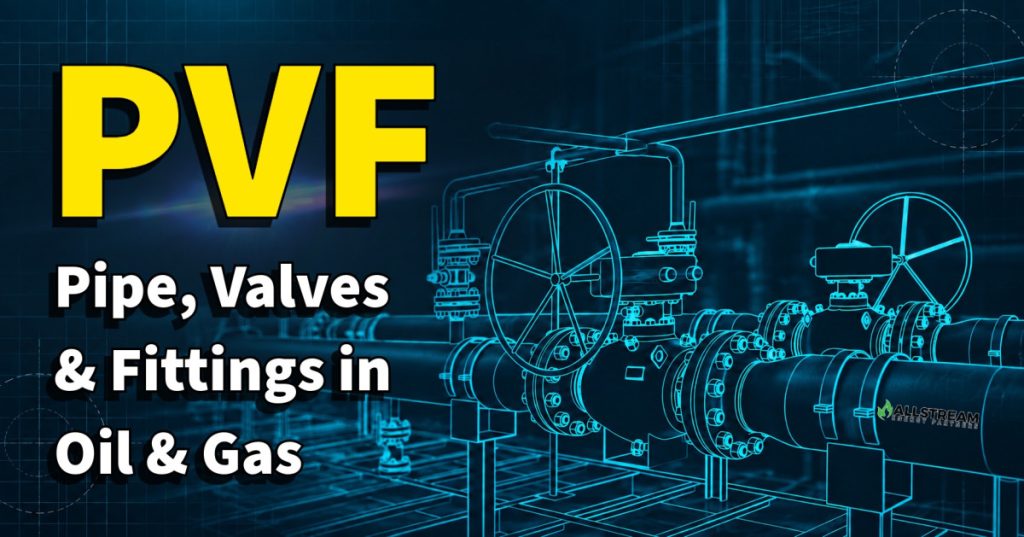
Executive Summary: PVF stands for pipe, valves and fittings—the components used to transport, isolate, regulate and redirect liquids, gases, steam and process chemicals across oil and gas infrastructure. PVF selection depends on the application, design conditions, materials, pressure class, temperature, corrosion exposure and applicable project standards. Severe-service and specialty valves may require application-specific engineering, advanced metallurgy, specialized trim, documented testing and material traceability before they can be accepted for major capital projects.
The PVF industry supplies essential components for upstream production, gathering systems, pipelines, LNG facilities, refineries, petrochemical plants, terminals and power-generation facilities. Understanding the different product categories, materials and qualification requirements helps explain how engineers and industrial buyers evaluate PVF manufacturers.
Published by Allstream Energy Partners
What Does PVF Stand for in Oil and Gas?
PVF stands for pipe, valves and fittings. These products form the pressure-containing systems used to transport and control crude oil, natural gas, refined products, water, steam, chemicals and other process fluids.
Depending on the supplier and market, the broader PVF category may also include:
- Flanges
- Gaskets and bolting
- Strainers
- Valve actuators and controls
- Instrumentation valves
- Tubing and tube fittings
- Specialty piping components
Where Are PVF Products Used?
PVF products are used throughout energy and industrial infrastructure. Common applications include:
- Oil and gas production facilities
- Gathering and transmission pipelines
- Compressor and pump stations
- Natural gas processing plants
- LNG liquefaction and regasification facilities
- Refineries and petrochemical complexes
- Terminals and storage facilities
- Power-generation plants
- Water-treatment facilities
- Industrial manufacturing operations
Product requirements can change substantially between applications. A valve intended for a low-pressure utility service may be evaluated differently from a valve exposed to high differential pressure, hydrogen sulfide, cryogenic temperatures or an erosive process fluid.
What Types of Pipe Are Used in the PVF Industry?
Line Pipe
Line pipe is used to transport oil, natural gas and other products through gathering and transmission systems. Steel line pipe may be specified to API Specification 5L, subject to the applicable service, project specifications and regulatory requirements.
Process Piping
Process piping is installed within facilities such as refineries, chemical plants, LNG facilities and gas-processing plants. ASME B31.3 commonly applies to process piping within its defined scope.
Power Piping
ASME B31.1 addresses power-piping systems within its scope, including piping associated with certain power-generation and industrial installations.
Pipeline Transportation Systems
ASME B31.4 addresses liquid and slurry pipeline transportation systems, while ASME B31.8 addresses gas transmission and distribution piping systems. The applicable code must be determined from the system, service, jurisdiction and project requirements.
What Materials Are Used for Industrial Pipe?
Pipe material is selected according to the process fluid, design pressure, temperature, corrosion exposure, mechanical requirements and applicable specifications.
Common material families include:
- Carbon steel
- Low-alloy and chromium-molybdenum alloy steel
- Austenitic stainless steel
- Duplex and super-duplex stainless steel
- Nickel-base alloys
- Nonmetallic and composite piping materials for applicable services
A broad material description does not establish suitability. The required grade, chemical composition, heat treatment, dimensions, manufacturing method, inspection and testing must comply with the applicable specification.
What Are Industrial Pipe Fittings?
Pipe fittings connect, redirect, branch, reduce or terminate piping systems. Their material, wall thickness, dimensions, pressure capability and end preparation must align with the connected piping and project requirements.
Common Types of Fittings
- Elbows: Change the direction of a piping run
- Tees: Create branch connections
- Reducers: Transition between pipe sizes
- Caps: Close the end of a pipe
- Couplings: Connect applicable pipe sections
- Unions: Provide a detachable connection in services where their use is permitted
- Olets and branch fittings: Create reinforced branch connections
Fitting selection should follow the governing piping code, dimensional standard, material specification and owner or project requirements.
What Types of Industrial Valves Are Used in Oil and Gas?
Industrial valves isolate equipment, prevent reverse flow, regulate process conditions or redirect flow through a piping system. The appropriate valve type depends on its intended function and service conditions.
Ball Valves
Ball valves use a rotating closure element and are commonly evaluated for isolation services requiring quarter-turn operation. Their design, seats, seals and materials vary by application.
Gate Valves
Gate valves are primarily used for isolation in fully open or fully closed service. They are generally not selected for continuous throttling unless specifically designed for that purpose.
Butterfly Valves
Butterfly valves use a rotating disc and can offer a compact configuration for applicable services and larger pipe sizes. Their suitability depends on the valve design, seat, pressure class and process conditions.
Globe and Control Valves
Globe-style and other control-valve designs may be selected for throttling and process control. Proper sizing and trim selection are important where the valve must manage pressure reduction, cavitation, flashing or noise.
Check Valves
Check valves are designed to prevent reverse flow. Their configuration and dynamic response should be evaluated for the specific piping system and operating conditions.
What Are Severe-Service Valves?
Severe-service valves are engineered for process conditions that may cause accelerated wear, unstable control, leakage or premature failure if the valve is not properly selected.
Severe-service conditions may include:
- High pressure or high differential pressure
- High or cryogenic temperatures
- Cavitation and flashing
- Outgassing
- Erosion from solids or high-velocity flow
- Corrosive or sour-service fluids
- Noise and vibration
- Frequent cycling
- Demanding shutoff or fugitive-emissions requirements
A severe-service solution may incorporate specialized trim, staged pressure reduction, modified flow paths, hardened components, corrosion-resistant alloys, hardfacing, weld overlays, specialized seats and seals, or application-specific actuation and controls.
The term “severe service” does not establish one universal valve design. Engineers must evaluate the actual process conditions and the manufacturer’s technical data.
Why Is Metallurgy Important in Valve Selection?
Valve metallurgy influences whether pressure-containing and wetted components can withstand the process environment. Material selection can affect strength, corrosion resistance, erosion resistance, fracture behavior, weldability and resistance to applicable cracking mechanisms.
Engineers may evaluate the metallurgy of the:
- Valve body and bonnet
- Stem or shaft
- Ball, gate, disc or plug
- Seats and sealing surfaces
- Control-valve trim
- Fasteners and pressure-retaining components
- Weld overlays and hardfacing
Potential material families include carbon steel, low-alloy steel, stainless steel, duplex and super-duplex stainless steel, and nickel-base alloys. The required material grade and chemical composition depend on the service and project specifications.
Which Metallurgical Records May Be Required?
Depending on the product and project, the manufacturer may be asked to provide or maintain:
- Material test reports or certified material test reports
- Heat-number traceability
- Chemical-composition and mechanical-property records
- Heat-treatment records
- Hardness-test results
- Positive material identification records
- Welding-procedure and welder-qualification documentation
- Nondestructive examination records
- Pressure and functional test reports
The required documentation must be determined from the purchase specification, inspection plan and applicable standards.
Which Standards May Apply to PVF Products?
PVF products should be evaluated against the standards and specifications applicable to their particular design and service. Examples may include:
- API Specification 5L for steel line pipe within its scope
- API Specification 6D for qualifying valve products within its scope
- ASME B31.1 for power piping
- ASME B31.3 for process piping
- ASME B31.4 for liquid and slurry pipeline transportation systems
- ASME B31.8 for gas transmission and distribution piping systems
- ASME B16.34 for covered valve construction, materials, pressure-temperature ratings, examination, testing and marking
- ISO 15156 for applicable metallic-material selection in hydrogen-sulfide-containing oil and gas production environments
This list is illustrative rather than exhaustive. Owner standards, jurisdictional requirements and project specifications may impose additional requirements. A qualified engineer must determine which standards apply.
What Is an Approved Manufacturer List – AML?
An Approved Manufacturer List identifies manufacturers accepted by an owner, EPC firm or project for designated products or applications. Other organizations may use an Approved Vendor List, approved supplier list or project-specific bidder list.
These terms are not always interchangeable. A manufacturer may be technically approved for a product while a distributor or representative serves as the commercial vendor.
Where an approved-list requirement applies, a manufacturer may need to complete a qualification or exception process before its product can be purchased.
How Are PVF Manufacturers Evaluated?
Manufacturer qualification may include technical, quality, manufacturing and commercial review. Depending on the product and customer, the process may evaluate:
- Product design and manufacturing capabilities
- Applicable certifications and quality systems
- Material control and traceability
- Inspection and testing procedures
- Manufacturing locations and capacity
- Technical documentation
- Reference installations and operating history
- Nonconformance and corrective-action procedures
- Delivery performance and commercial support
- Customer or third-party audits
Qualification requirements vary by customer and application. Marketing can help organize and communicate a manufacturer’s documented qualifications, but it cannot replace technical approval.
How Do Industrial Buyers Evaluate PVF Suppliers?
Industrial buyers evaluate more than the product itself. Depending on the project, purchasing decisions may consider:
- Approved-manufacturer or supplier status
- Compliance with the material requisition and datasheets
- Technical performance and relevant operating history
- Material availability and manufacturing lead time
- Inspection, testing and documentation capabilities
- Quality and traceability systems
- Commercial competitiveness
- Engineering and application support
- Delivery, logistics and expediting capabilities
- Repair and lifecycle support
Specialty and severe-service valves may command a premium price when they incorporate application-specific engineering, advanced materials, specialized trim or additional testing. That premium must be supported by documented technical value rather than generalized claims about quality.
Key Takeaways About PVF in Oil and Gas
- PVF stands for pipe, valves and fittings.
- PVF requirements depend on the application, process conditions and project specifications.
- Process piping, liquid pipelines, gas pipelines and power piping may be governed by different codes.
- Severe-service valves may require specialized designs, materials, trim and testing.
- Valve metallurgy can influence corrosion resistance, mechanical performance and technical qualification.
- Material traceability and testing may be as important as the general material family.
- AML and AVL requirements vary by owner, EPC firm and project.
- Marketing supports technical communication but does not replace engineering review or approved-manufacturer qualification.
How Allstream Energy Partners Supports PVF Manufacturers
Allstream Energy Partners helps PVF manufacturers communicate complex technical capabilities to engineers, EPC firms, procurement teams and other oil and gas decision-makers.
Our capabilities include technical content, market positioning, SEO, Answer Engine Optimization, Generative Engine Optimization, business-development support, project intelligence, media distribution and industry visibility.
Allstream does not engineer, certify or approve PVF products. Our role is to help qualified manufacturers present their verified applications, materials, standards, testing and execution capabilities clearly and credibly.
PVF manufacturers seeking support with market positioning, technical content, search visibility and business development can explore Allstream Energy Partners’ oil and gas digital-marketing services.