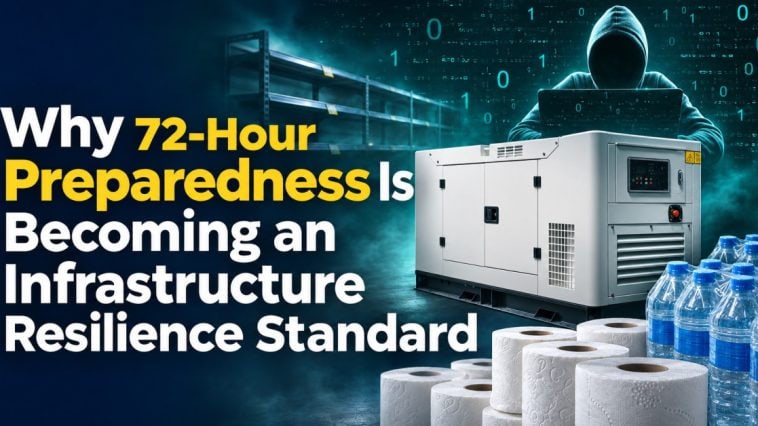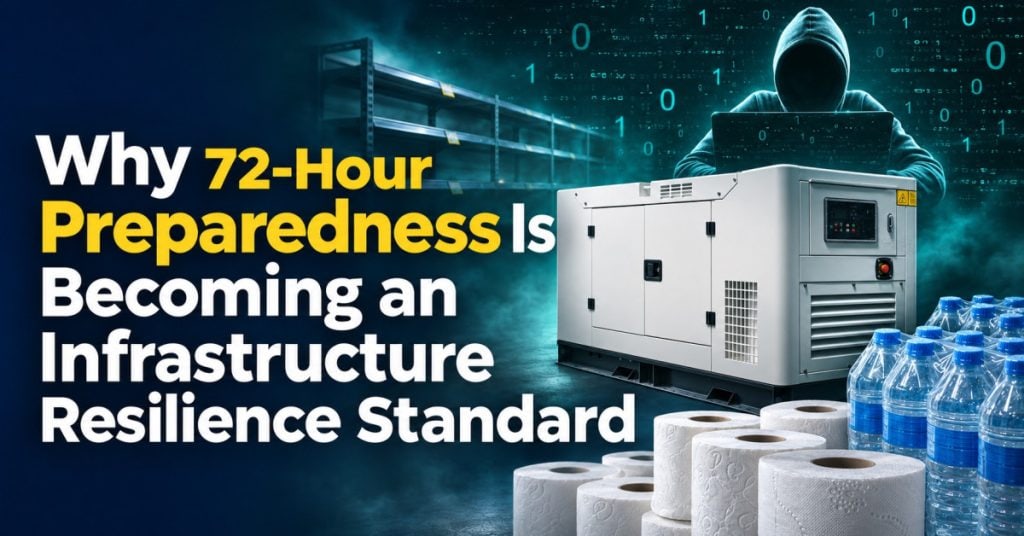
Recent preparedness guidance in the United Kingdom, Europe, Germany and Japan focuses on short-term self-sufficiency during disruptions—not on a forecast of one specific event—while placing renewed attention on the systems that keep power, water, food and communications available.
Published by Allstream Insiders
Allstream Insiders Summary
Government preparedness guidance is again drawing attention to the resilience of essential services. The United Kingdom launched its “Be Ready” public campaign in October 2026, advising households to take practical steps for up to three days of disruption to services such as power, water, internet and communications. The European Union’s 2025 Preparedness Union Strategy promotes a goal of at least 72 hours of household self-sufficiency during emergencies.
National guidance varies. Germany’s Federal Office of Civil Protection and Disaster Assistance advises people to work toward the ability to support themselves for up to 10 days, while Japan’s 2026 disaster-preparedness materials recommend maintaining at least three days of food, water and essential supplies, preferably about a week.
These are preparedness recommendations, not mandatory stockpiling directives or evidence that governments expect one imminent crisis. None of the government materials reviewed identifies the U.S. midterm election as the reason for the guidance. Their shared message is that households, communities, businesses and public agencies should be better able to manage the early period of a wide range of disruptions.
Preparedness guidance at a glance
| Government or organization | Reported household-readiness guidance | Context described in the source material |
|---|---|---|
| United Kingdom | Prepare for up to three days of disruption | Severe weather and temporary disruptions to services including power, water, internet and communications |
| European Union | Promote a minimum of 72 hours of self-sufficiency | An all-hazards approach covering risks such as climate events, cyber incidents, supply disruptions and geopolitical threats |
| Germany | Work toward up to 10 days of self-sufficiency; at least three days is still useful | Civil-protection preparedness for crises and disasters |
| Japan | At least three days of supplies, preferably about one week | Natural-disaster readiness, including potential interruptions to electricity, gas, water and communications |
What governments are—and are not—saying
The strongest common thread is resilience, not a prediction. The guidance is intended to help people meet basic needs during the first hours or days of a severe storm, natural disaster, cyber incident, infrastructure failure or other emergency while response agencies concentrate resources where they are most needed.
That distinction matters. A recommendation to keep food, water, medication, batteries, lights and communications tools available is not the same as a declaration of emergency, an instruction to hoard goods or a warning that a specific disruption is expected. The length of recommended household preparedness also differs by country because it reflects national risk profiles, civil-defense systems, weather exposure, geography and emergency-response planning.
Why connected physical systems are part of the discussion
Preparedness increasingly involves the equipment that keeps essential services operating. Water treatment, power distribution, refrigeration, building controls, fuel handling, telecommunications and industrial processes rely on operational technology that must be both reliable and appropriately secured.
According to October 29 Reuters reporting, Pentagon investigators are examining whether unusual freezer malfunctions that spoiled food at at least six U.S. military commissaries in August were caused by a cyberattack. The reported investigation does not establish that a cyberattack occurred, identify a responsible actor or confirm the cause of the failures.
The episode nevertheless illustrates a practical issue for facility operators: a disruption to connected refrigeration or control equipment can affect food availability, inventory, operations and public confidence even when broader power infrastructure remains available. The same continuity question applies to industrial control systems used in pumping, process operations, water treatment, backup generation and remote equipment monitoring.
What this could mean for energy and industrial operators
For critical-infrastructure owners, readiness is an integrated operating discipline rather than a single equipment purchase. The appropriate plan will differ by asset, location, regulatory obligations and process risk, but potentially relevant areas can include:
- backup generation, batteries, microgrids and resilient electrical distribution;
- fuel storage, fuel logistics and emergency refueling arrangements;
- redundant water treatment, pumping, storage and wastewater capabilities;
- industrial-control cybersecurity, secure remote access, asset inventories and continuous monitoring;
- cold-chain and refrigeration continuity planning for food, pharmaceutical and industrial facilities;
- spares, critical-equipment availability, supplier continuity and maintenance support; and
- emergency communications, training, recovery procedures and coordination with local responders.
A 72-hour household goal should not be treated as an engineering standard for a pipeline, refinery, utility, data center, plant or water system. Industrial continuity requirements must be developed around the particular facility’s hazards, load profile, inventory, permit obligations, customers and safety systems.
Allstream perspective: Resilience is becoming a commercial requirement
Allstream perspective: Public preparedness campaigns reinforce a broader market reality: continuity planning has become a more visible expectation for owners of essential systems. The work can extend beyond emergency generators and spare parts to encompass electrical infrastructure, controls, communications, water, fuel, supply chains, cybersecurity and workforce readiness.
For energy and industrial suppliers, the commercial signal will come when owners translate broad resilience objectives into defined assessments, capital plans, cybersecurity programs, equipment specifications, service agreements and construction packages. Until then, public preparedness guidance should be read as a policy and risk-management trend—not as proof of an impending widespread outage or a blanket procurement mandate.