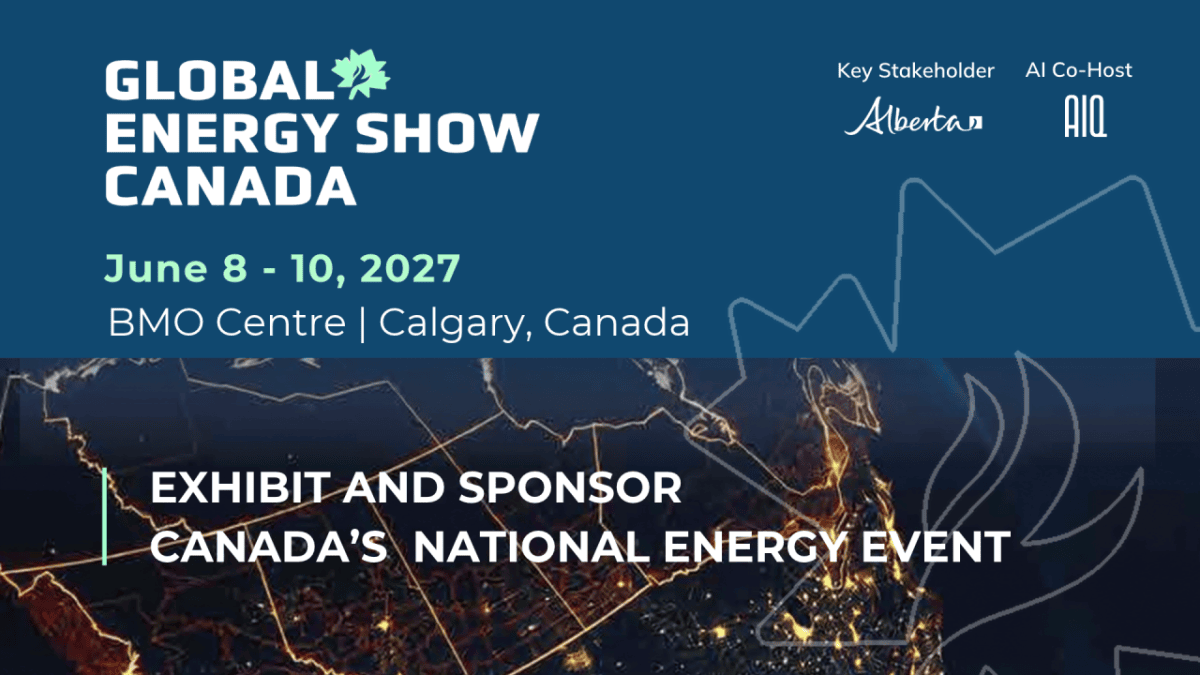
Register now for the 2027 Global Energy Show Canada held at BMO Centre June 8-10, 2027
Canada’s energy sector has moved from planning to building. In the past few months, LNG Canada committed to doubling its capacity, Alberta filed for a new West Coast oil pipeline, and Ottawa backed a series of critical minerals processing projects.
Each of those decisions creates demand somewhere else. LNG growth needs pipeline capacity. Data centres need firm power. Electrification needs minerals. Emissions commitments run through all of it. Projects now succeed or stall on supply chains, grid access and how quickly operators find the right partners, more than on capital alone.
Global Energy Show Canada 2027 is built around that reality. The exhibition floor is organized into seven zones, each representing a segment of the energy economy where investment decisions are being made now. Here is where each stands heading into June.
Why Exhibit
Meet Energy Project Developers
Developers, operators and infrastructure companies attend to source the technologies, services and expertise needed to advance energy projects. Put your capabilities in front of the teams building and operating critical infrastructure.
Access International Buyers
Buyers, delegations and procurement teams from 100+ countries connect with suppliers, assess solutions and identify potential partners across the global energy value chain.
Reach Capital and Government
Ministers, premiers, investors and Indigenous leaders engage with the industry to shape energy policy, investment and project development. Build relationships with the stakeholders influencing the sector’s future.
The Teams Advancing Energy Projects
LNG developers, gas producers, pipeline and midstream companies and EPCs come to Calgary to source the capability their projects require.
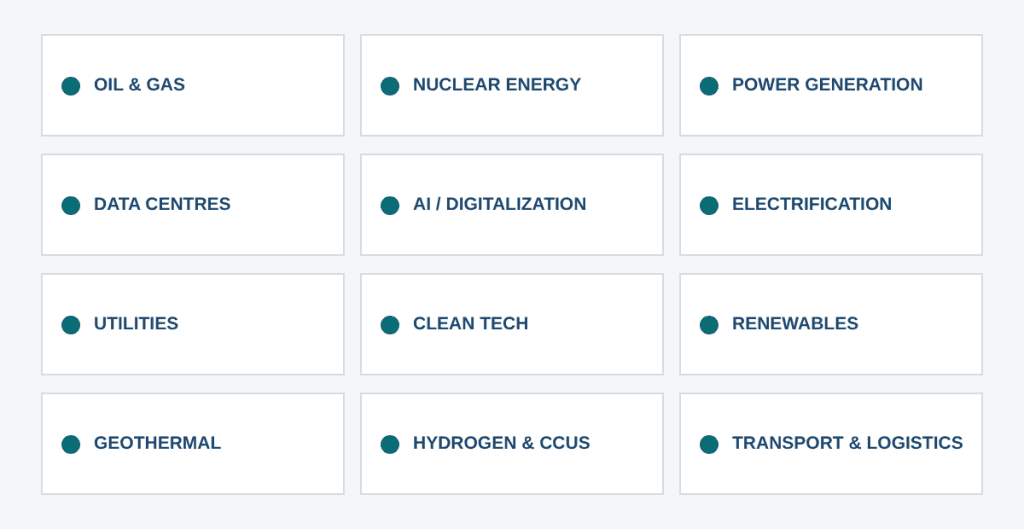
Buying teams from the following sectors attend Global Energy Show Canada:
Explore Seven Dedicated Exhibition Zones
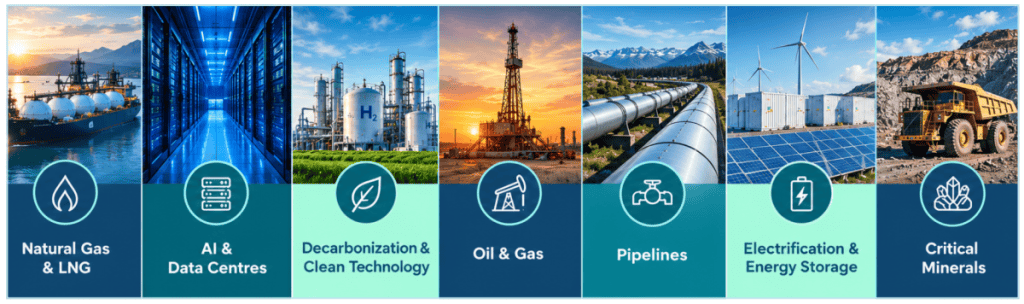
Natural Gas & LNG: Phase 2 is a go
On September 29, Shell, PETRONAS, PetroChina, Mitsubishi Corporation and KOGAS took a final investment decision on LNG Canada Phase 2. The expansion will double the Kitimat facility’s capacity to 28 million tonnes per annum. Phase 1 has shipped more than 100 cargoes since start-up in June 2025. The effects reach upstream: Coastal GasLink will build five new compressor stations to expand its 670-kilometre pipeline. The supply chain now has until the early 2030s to scale.
AI & Data Centres: Bring your own power
Companies have asked to connect roughly 19,565 megawatts of new data centre load in Alberta, more than the province’s all-time peak demand. The grid cannot absorb that, so the rules have changed. Under the Data Centre Regulation, in force since June 2026, projects that pair demand with dedicated new generation or storage move to the front of the queue. The Alberta Utilities Commission has already approved the Greenlight Electricity Centre, a 1.9-gigawatt gas-fired plant expected to supply a large data centre development. Energy producers are becoming partners to data centre developers, not just suppliers.
Decarbonization & Clean Technology: Pathways gets a framework
In July, Ottawa, Alberta and the five producers in the Oil Sands Alliance (formerly the Pathways Alliance) signed an agreement to advance the Pathways carbon capture and storage project. Pathways is the condition attached to a new West Coast pipeline. Federal investment tax credits for carbon capture now extend to 2035, and Alberta will extend its own Carbon Capture Incentive Program to match. The first phase is designed to capture and store about six million tonnes of CO₂ a year, with infrastructure in service by 2032. For suppliers of capture, compression, monitoring, methane abatement and low-carbon fuels technology, the policy question is settled. Procurement is next.
Oil & Gas: Two engines of growth
Oil sands production is expected to reach a record 3.5 million barrels per day in 2026, its 25th consecutive year of growth, driven largely by optimizing existing facilities. Conventional activity is rising as well. In May 2026, 424 wells were drilled across the Western Canadian Sedimentary Basin, the most in 12 years. Shell’s estimated $16 billion acquisition of ARC Resources shows capital following. In both segments, efficiency and drilling performance remain at the centre of operator spending.
Pipelines: A new corridor on the table
Trans Mountain has run at full capacity through the second and into the third quarter of 2026, and the next corridor is now formally proposed. The West Coast Oil Pipeline would carry one million barrels per day from Bruderheim, Alberta, to a deepwater port near Delta, B.C. Alberta is aiming for design and construction to begin as early as September 1, 2027. Holding that timeline through consultation, financing and shipper commitments will be the real test.
Electrification & Energy Storage: The grid needs to double
Electricity demand in Canada is expected to double by 2050, and Ottawa announced a forthcoming National Electricity Strategy in May 2026. Investment is starting to follow. In September, Ottawa marked the opening of Atlantic Canada’s largest energy storage facilities, backed by $109 million in federal funding. Data centres, LNG and industrial electrification are all arriving on the same system. Generation, transmission and storage will need to grow faster than they have in decades.
Critical Minerals: Processing moves to the front
Policy has moved from extraction to processing. In July, Ottawa announced up to $400 million for Teck’s critical minerals operations in Trail, B.C. It is the first deal under the Canada Critical Mineral Accelerator, and it supports an expansion that could double germanium and antimony production and add new gallium capacity. It followed 30 federal agreements with 12 allied countries aimed at unlocking about $12.1 billion in mining and processing investment. The challenge now is speed: building processing capacity fast enough to compete with established supply chains.
Beyond the Seven Zones: Outdoor Exhibition
Alongside the seven zones, the Outdoor Exhibition puts working equipment in front of buyers at full scale. Drilling rigs, pumps, fleet vehicles, field machinery and renewable energy hardware will be on site, with live demonstrations and product testing.
Seven zones, one show
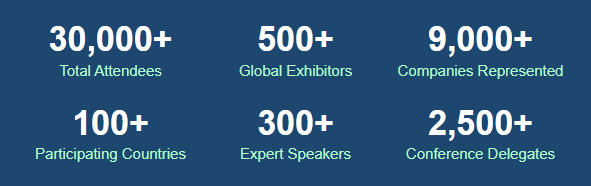
Global Energy Show Canada 2027 brings all seven segments together in Calgary from June 8 to 10. The operators, developers, investors and suppliers driving each of them will be on the floor, alongside the ministers and Indigenous leaders shaping policy and investment. We expect more than 30,000 attendees, 500 exhibitors and delegations from over 100 countries.
June 8–10, 2027 | BMO Centre, Calgary
The decisions above are now turning into contracts. If your company supplies any of these segments, there is a zone built for you. Exhibition space and sponsorship packages for 2027 are now available across all seven zones and the Outdoor Exhibition.