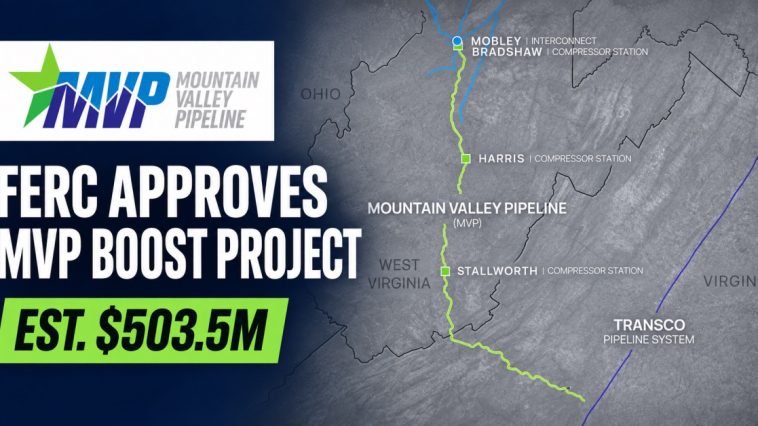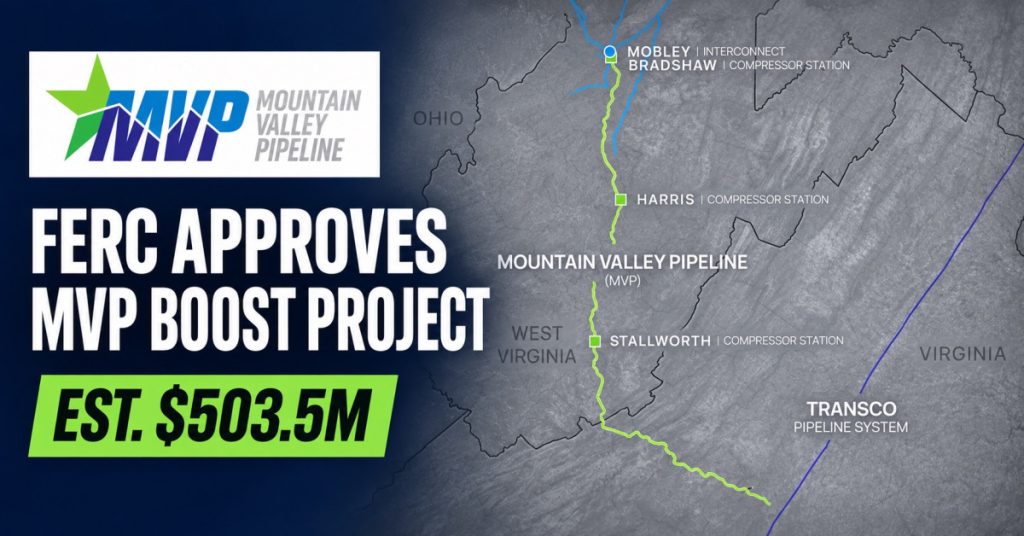
The certificate authorizes approximately 265,750 horsepower of new compression and up to 600,000 Dth/day of additional firm transportation capacity on the existing Mountain Valley Pipeline system.
Published by Allstream Insiders – By Efrain Garcia, Publisher
Allstream Insiders Summary
The Federal Energy Regulatory Commission issued Mountain Valley Pipeline, LLC a certificate on November 19, 2026, authorizing the MVP Boost Project. According to FERC’s order, the project is designed to add up to 600,000 dekatherms per day of firm natural-gas transportation capacity on the existing MVP Mainline.
Mountain Valley estimates total project cost at approximately $503.5 million. The authorized scope consists primarily of additional compression at three existing West Virginia compressor stations and a new compressor station in Montgomery County, Virginia.
The FERC certificate is a major federal authorization, but it does not mean every remaining permit, certificate condition, contractor scope or construction notice has been completed. The project remains subject to FERC’s conditions and other required approvals, including applicable air-permit requirements.
MVP Boost at a glance
| Item | FERC-reported detail |
|---|---|
| Project | MVP Boost Project |
| Developer | Mountain Valley Pipeline, LLC |
| Estimated project cost | Approximately $503.5 million |
| New transportation capacity | Up to 600,000 Dth/day |
| Added compression | Approximately 265,750 ISO-rated horsepower |
| New facility | Swann Compressor Station, Montgomery County, Virginia |
| Existing stations to be expanded | Bradshaw, Harris and Stallworth compressor stations in West Virginia |
| Capacity under precedent agreements | 600,000 Dth/day, representing the full proposed project capacity |
| FERC action | Certificate issued November 19, 2026 |
| In-service requirement | Facilities must be completed and available for service within two years of the order, subject to FERC requirements |
What FERC approved
MVP Boost is a compression-led expansion of the existing Mountain Valley Pipeline system, rather than a new long-haul pipeline route. FERC authorized Mountain Valley to add compression in Wetzel, Braxton and Fayette counties, West Virginia, and to construct the new Swann Compressor Station in Montgomery County, Virginia.
The certified scope includes:
- An additional 23,470-horsepower compressor unit at the Bradshaw Compressor Station in Wetzel County;
- A new 52,500-horsepower compressor unit, turbine restaging and related work at the Harris Compressor Station in Braxton County;
- Additional compressor units, turbine upgrades and related work at the Stallworth Compressor Station in Fayette County; and
- The new 136,900-horsepower Swann Compressor Station in Montgomery County, including three natural-gas-fired turbine-driven compressor units, a pig launcher and receiver, a mainline block valve, auxiliary facilities and approximately 0.2 mile of 42-inch dual suction-and-discharge piping.
The project’s added compression is designed to increase throughput on the existing mainline while operating within the pipeline’s approved maximum allowable operating pressure.
Capacity is fully contracted
FERC found that Mountain Valley executed long-term precedent agreements covering the full 600,000 Dth/day of proposed incremental capacity.
The contracted capacity is allocated among:
- Duke Energy Carolinas, LLC: 275,000 Dth/day;
- Virginia Power Services Energy Corp., Inc.: 200,000 Dth/day; and
- Public Service Company of North Carolina, Inc.: 125,000 Dth/day.
The contracted commitments were central to FERC’s finding that the project is needed to serve utility, local-distribution and power-generation demand in Mid-Atlantic and Southeastern markets.
What approval does—and does not—mean
FERC’s certificate authorizes Mountain Valley to construct and operate the project subject to the conditions in the order. It is not the same as confirmation that all field work has begun.
The certificate does not replace remaining federal, state or local requirements. The new Swann Compressor Station, for example, still requires applicable Clean Air Act authorization before construction of that facility may proceed.
The order also does not identify awarded engineering firms, construction contractors, electrical contractors, civil contractors or equipment-installation subcontractors. While FERC’s order identifies the proposed compressor configuration, it should not be interpreted as confirmation that all associated equipment and service packages have been purchased or awarded.
What MVP Boost could mean for the midstream supply chain
Allstream perspective: FERC certification moves MVP Boost beyond the application and environmental-review stage and establishes a defined compression-expansion scope with a company-estimated cost of approximately $503.5 million. Because the project relies heavily on compressor-station additions and modifications, future execution could involve a broad set of specialized midstream services.
Potential work categories for a project of this type could include detailed engineering and design; gas-compression packages; turbine and auxiliary systems; station piping; valves and actuators; pigging equipment; measurement, controls and automation; electrical distribution; civil work; foundations; structural steel; welding and inspection; hydrostatic testing; coatings; insulation; scaffolding; equipment rentals; environmental compliance; commissioning; and long-term maintenance support.
Those categories describe potential requirements for a compression-led project of this nature. They are not disclosed procurement packages, contractor awards or confirmed supplier opportunities.
What to watch next
The next material milestones are likely to be completion of remaining permits, satisfaction of FERC preconstruction conditions, release of detailed construction timing, engineering progression and any contractor or equipment announcements.
MVP Boost is now federally certificated, but the market should distinguish that milestone from a full construction mobilization. Project execution will become clearer as Mountain Valley discloses permits, notices to proceed, procurement activity and construction schedules.