The fivefold expansion creates additional financing capacity for rapidly deployed onsite fuel-cell projects serving AI infrastructure, but the companies have not assigned the full amount to named sites or disclosed a new aggregate megawatt target.
Published by Allstream Insiders.
Allstream Insiders Summary
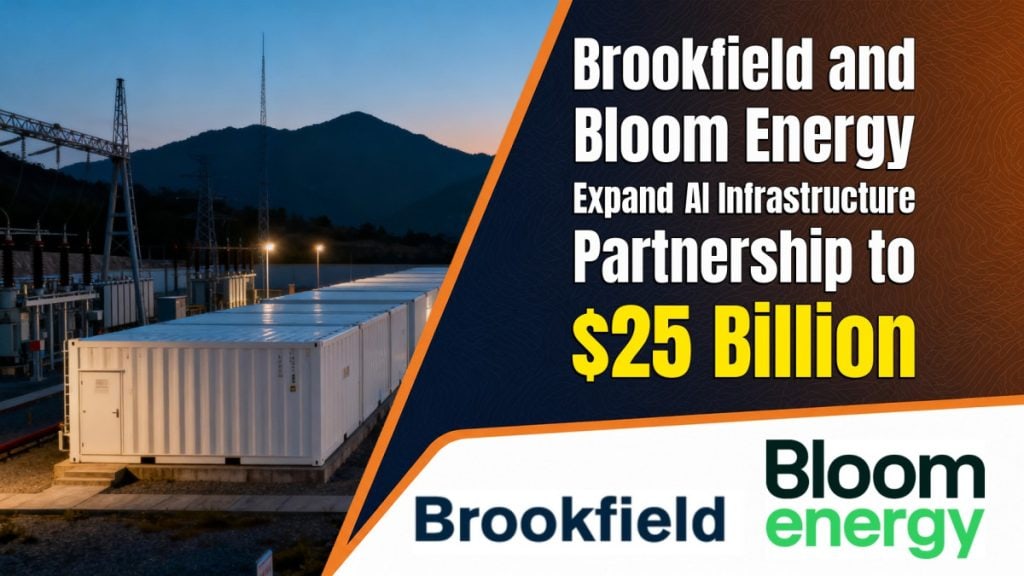
Brookfield and Bloom Energy have expanded their global AI-infrastructure power partnership from $5 billion to $25 billion, increasing the framework fivefold less than nine months after it was established.
The partnership combines Brookfield’s infrastructure development and financing capabilities with Bloom Energy’s modular solid oxide fuel cell systems. The companies intend to build and finance onsite power for hyperscalers, data-center developers and other AI-infrastructure customers that require electricity faster than conventional grid expansion may allow.
The $25 billion figure is a financing framework for potential power projects. It is not a single-project construction budget, a purchase order issued to Bloom Energy or confirmation that $25 billion has already been allocated to specific sites. The June 30 announcement does not identify new customers, locations, project capacities, construction schedules or regulatory approvals.
The expanded collaboration is part of Brookfield’s dedicated AI Infrastructure Fund, which was launched with a target to deploy $100 billion across AI factories, power systems, computing infrastructure and strategic capital partnerships.
Prior Brookfield disclosures provide evidence that the original framework moved beyond concept stage. Brookfield reported completing an initial 55 MW behind-the-meter installation at a U.S. data center and securing additional hyperscaler projects that brought the total to approximately 230 MW by the end of 2025. The June expansion does not state whether the $25 billion framework replaces the original capacity target or establish an updated megawatt figure.
What Changed in the Brookfield–Bloom Energy Partnership?
| Framework item | Confirmed detail |
|---|---|
| Partners | Brookfield and Bloom Energy |
| Original framework | Up to $5 billion, announced October 13, 2025 |
| Expanded framework | $25 billion, announced June 30, 2026 |
| Increase | Fivefold, adding $20 billion of potential financing capacity |
| Intended market | AI factories, hyperscalers and data-center infrastructure |
| Geographic scope | Global |
| Power technology | Bloom Energy onsite solid oxide fuel cell systems |
| Brookfield role | Infrastructure development, financing and operating scale |
| Bloom Energy role | Rapidly deployable onsite power platform and associated equipment |
| New project list | Not disclosed |
| Updated capacity target | Not disclosed |
| Project schedules | Not disclosed |
The expansion increases the amount Brookfield may use to finance projects developed with Bloom Energy. It does not, by itself, establish that an individual site has reached final investment decision, received permits, entered construction or ordered equipment.
The Partnership Targets Onsite Power for AI Factories
Brookfield and Bloom Energy are organizing the partnership around an integrated “AI factory” model. In this approach, electrical generation, computing equipment, data-center design and financing are planned together instead of treating power as a utility connection added after the data-center site is selected.
Bloom’s Energy Server systems are designed to generate electricity at or near the point where it is consumed. Depending on project design, the systems can operate in parallel with the utility grid, as part of a microgrid or as an off-grid load-following system.
For data-center developers, onsite generation can reduce dependence on the timing of new transmission lines, substations and utility generation. It can also allow power capacity to be installed in modular blocks as a campus develops. Site-specific utility, gas, permitting and interconnection requirements still apply; onsite generation does not eliminate every infrastructure constraint.
The June announcement describes customer demand for “islanded” power solutions. An islanded system is capable of serving the designated load independently from the wider grid. The announcement does not state whether every project financed under the framework will be fully islanded, grid-parallel or configured as a microgrid.
How Bloom Energy’s Solid Oxide Fuel Cells Produce Electricity
Bloom Energy Servers use solid oxide fuel cell (SOFC) technology to convert fuel into electricity through an electrochemical process rather than conventional combustion.
Bloom says the platform can operate on natural gas, biogas, hydrogen or blended hydrogen. The primary power modules convert the fuel into direct-current electricity, and the system conditions that output for use by the customer’s facilities.
The modular platform is intended for continuous onsite generation and can be scaled by adding Energy Server units. Bloom markets data-center configurations ranging from 20 MW to 500 MW, although the partners have not said that every project under the framework will fall within that range.
The fuel source matters when assessing emissions. A fuel-cell project operating on natural gas remains a source of carbon dioxide even though the electrochemical process avoids conventional combustion and substantially reduces local criteria pollutants. A system’s actual emissions profile depends on its fuel, operating configuration and any associated carbon-management equipment. The June partnership announcement does not disclose the planned fuel mix for future projects.
The Original Framework Produced at Least 230 MW of Project Activity
Brookfield and Bloom Energy announced the original $5 billion partnership on October 13, 2025. At that time, Bloom was identified as Brookfield’s preferred onsite power provider for global AI factories, and the companies said they were collaborating on projects worldwide.
Brookfield later described the initial framework as supporting up to 1 GW of behind-the-meter power generation. In its year-end 2025 infrastructure update, Brookfield reported that the inaugural project had installed 55 MW of power for a U.S. data-center site. It also said additional projects for several hyperscaler customers increased the framework’s secured generation capacity to approximately 230 MW, with contract terms of at least 15 years.
Those figures establish a documented operating and contracted base under the earlier framework. They do not mean the June 2026 expansion has already produced another 20 GW, 5 GW or any other undisclosed amount of capacity. The relationship between the expanded $25 billion amount and the earlier 1 GW capacity description has not been explained publicly.
Brookfield’s AI Infrastructure Fund Provides the Capital Platform
The expanded Bloom Energy collaboration sits within Brookfield’s dedicated AI Infrastructure Fund. Brookfield launched the program in November 2025 with a $100 billion deployment target covering large AI factories, power solutions, computing infrastructure and strategic partnerships.
The Bloom Energy framework addresses the power component. Brookfield can combine project development and financing with other digital-infrastructure capabilities, while Bloom supplies the modular onsite generation platform.
The $25 billion Bloom framework and Brookfield’s $100 billion AI-infrastructure target should not be added together as separate committed spending programs. The Bloom partnership is described as part of the larger Brookfield strategy.
What the Expansion Could Mean for the Supply Chain
A global onsite-power program of this potential scale could create demand across fuel-cell manufacturing, site engineering, gas and hydrogen infrastructure, electrical balance of plant, microgrid controls, substations, commissioning and long-term service.
The most relevant categories to monitor include:
- Bloom Energy Server manufacturing and module delivery.
- Natural-gas or alternative-fuel interconnections and metering.
- Site grading, foundations and equipment installation.
- Inverters, transformers, switchgear and protection systems.
- Microgrid controls, load management and cybersecurity.
- Electrical integration between power systems and data-center campuses.
- Air-quality, environmental and construction permitting.
- System commissioning, monitoring and lifecycle maintenance.
- Potential heat-recovery or carbon-management equipment where included in a specific design.
The June announcement does not name engineering firms, construction contractors, gas utilities, equipment suppliers beyond Bloom Energy, or individual procurement packages. The framework creates a project-development channel, but vendor opportunities must be verified site by site.
Allstream Perspective
The Brookfield–Bloom expansion shows that rapid onsite power is becoming a core part of AI-infrastructure development rather than a temporary bridge while data centers wait for grid service. Brookfield is increasing the available financing framework, while Bloom Energy supplies a modular generation technology that can be deployed at the customer’s site.
The most commercially important change is the increase from $5 billion to $25 billion. The strongest evidence of execution remains the previously disclosed 55 MW installation and approximately 230 MW of secured projects under the original framework.
For contractors and suppliers, the next meaningful signals will be named sites, equipment orders, permits, fuel arrangements and construction contracts. Until those disclosures appear, the $25 billion amount should be treated as global financing capacity—not as a single project budget or an awarded construction backlog.