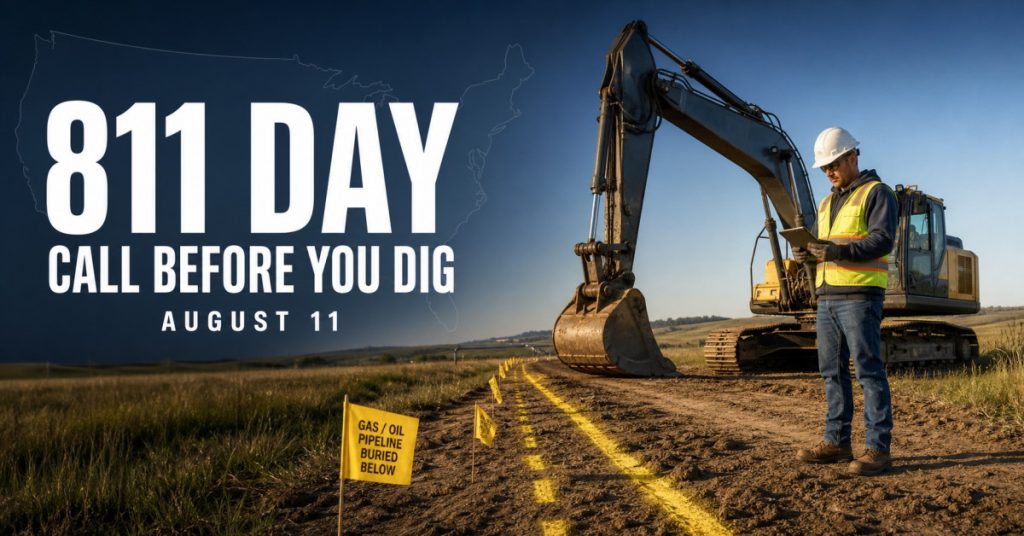
August 11 reinforces the nationwide call-before-you-dig system, with a state-by-state directory for pipeline, facility and industrial excavation planning.
Published by Allstream Insiders.
Allstream Insiders Summary
811 Day is observed on August 11 — 8/11 — as a nationwide reminder to contact 811 before starting an excavation. A locate request alerts participating underground-facility owners and operators so they can respond and identify facilities that may conflict with the planned work.
For the oil and gas industry, the process applies far beyond mainline pipeline construction. It can affect excavation around gathering systems, well pads, compressor and processing facilities, terminals, refineries, LNG facilities, tank farms, utility crossings and rights-of-way.
The Pipeline and Hazardous Materials Safety Administration says excavation damage remains the leading cause of pipeline incidents across the nation’s 3.3 million miles of pipeline. PHMSA also reports that research shows contacting 811 before digging provides a 99% chance of avoiding an incident, injury, environmental harm or death.
The number is national, but the rules are not identical in every state. Required notice periods, ticket life, tolerance zones, positive-response procedures and emergency requirements vary. The state-by-state directory below provides each jurisdiction’s official one-call center, direct phone number and website.
What Is 811 Day?
811 Day uses August 11 to reinforce the three-digit number contractors, utilities and property owners use before excavation. The observance is supported by PHMSA, the Common Ground Alliance and state one-call centers as part of the broader effort to prevent damage to underground infrastructure.
Calling 811 or submitting a request through a state center’s website does not send a federal inspector or a single nationwide locating crew. The one-call center creates a ticket and notifies participating facility owners or operators whose registered service areas overlap the proposed excavation. Those companies then respond, typically by marking their facilities or issuing a positive response that no conflict exists.
The locate-request service is generally free to the excavator. However, private or nonmember facilities may not be included. Industrial sites, refineries, terminals, plants, well pads and other privately operated properties may therefore require additional operator coordination, site drawings and a private utility locator.
Why 811 Matters to the Oil and Gas Industry
Excavation damage can affect the pipe itself and the systems that protect or operate it. PHMSA’s federal excavation rules define damage broadly enough to include impacts requiring repair or replacement of pipe, protective coating, supports, cathodic-protection components or related facilities.
Oil and gas work that may require a locate request includes:
- Pipeline trenching, replacements, tie-ins and integrity digs.
- Road, railroad, utility and foreign-pipeline crossings.
- Well-pad, gathering-line and produced-water construction.
- Compressor-station, gas-processing and fractionation work.
- Terminal, tank-farm, refinery, petrochemical and LNG excavation.
- Foundations, grading, fencing, drainage and access-road work.
- Boring, drilling, piling, vacuum excavation and soil sampling.
- Maintenance work near buried electrical, fiber, water, sewer, instrument-air or control systems.
An unplanned strike can injure workers, release natural gas or hazardous liquids, damage coatings, interrupt production and trigger emergency response. It can also create a latent integrity concern even when there is no immediate leak. For that reason, PHMSA requires pipeline damage to be reported to the operator at the earliest practical moment, whether or not a release occurs. If excavation damage causes a release, the excavator must also call 911.
How the 811 Process Works Before Excavation
A valid ticket begins the damage-prevention process; it does not by itself authorize excavation. Contractors should also satisfy the applicable permit, right-of-way, operator, facility and job-safety requirements.
- Define the work area. Identify the excavation limits, scope, method and expected start date. White-line or electronically map the proposed area when required or useful.
- Contact the correct state center. Dial 811 from the state where the work will occur or use that center’s online ticket system. For multistate projects, create the required tickets in each jurisdiction.
- Wait the state-required period. Do not use a generic 48- or 72-hour assumption. Follow the timing shown by the applicable state center and account for weekends and holidays.
- Confirm every response. Check the ticket’s positive-response record and verify that each notified facility owner has marked, cleared or otherwise responded to the request.
- Review the site before digging. Compare the field markings with visible facilities, records and the planned work. Stop and seek a re-notification or operator response if something does not match.
- Expose and excavate carefully. Follow the state’s tolerance-zone requirements and the facility owner’s procedures. Marks identify an approximate horizontal location and should not be treated as proof of depth.
- Protect the marks and ticket. Preserve markings, monitor ticket expiration and request a remark or update when the work continues beyond the allowed period or marks are no longer usable.
- Report any contact. Notify the facility owner promptly about a scrape, dent, coating disturbance, cathodic-protection contact or other damage, even without a leak. Move to a safe location and call 911 when a release or immediate hazard exists.
No crew should assume that another contractor’s ticket, a previous project ticket or an operator’s internal drawing automatically covers its company, excavation limits, method and schedule. Coverage and ticket-transfer rules are state-specific.
Underground Utility Marking Colors
Yellow is the principal marking color for gas, oil, steam, petroleum and other gaseous materials. The Common Ground Alliance’s Best Practices guide lists the APWA uniform color code used nationwide, subject to any different state requirement.
| Marking color | Typical meaning |
|---|---|
| White | Proposed excavation |
| Pink | Temporary survey markings |
| Red | Electric power lines, cables, conduit and lighting cables |
| Yellow | Gas, oil, steam, petroleum or gaseous materials |
| Orange | Communications, alarm or signal lines, cables or conduit |
| Blue | Potable water |
| Purple | Reclaimed water, irrigation and slurry lines |
| Green | Sewers and drain lines |
State-by-State 811 Contact Directory
Dial 811 from the state where the excavation will occur. The direct numbers below provide an additional way to reach the appropriate center, while their websites provide online ticketing, state requirements and current operating information. California, Idaho, Illinois and New York have more than one regional center.
| State or jurisdiction | Official one-call center | Contact |
|---|---|---|
| Alabama | Alabama 811 | 811 or 800-292-8525 |
| Alaska | Alaska Digline, Inc. | 811 or 800-478-3121 |
| Arizona | Arizona 811 | 811 or 800-782-5348 |
| Arkansas | Arkansas 811 | 811 or 800-482-8998 |
| California | USA North 811 for northern and central California; DigAlert for southern California | 811; USA North: 800-642-2444; DigAlert: 800-422-4133 |
| Colorado | Colorado 811 | 811 or 800-922-1987 |
| Connecticut | Connecticut — Call Before You Dig | 811 or 800-922-4455 |
| Delaware | Delmarva 811 | 811 or 800-282-8555 |
| District of Columbia | Miss Utility | 811 or 202-265-7177 |
| Florida | Sunshine 811 | 811 or 800-432-4770 |
| Georgia | Georgia 811 | 811 or 800-282-7411 |
| Hawaii | Hawaii 811 | 811 or 866-423-7287 |
| Idaho | Dig Line, Inc. for most of Idaho; North Idaho 811 for Shoshone and Benewah counties; Dig Safe North Idaho 811 for Bonner, Boundary and Kootenai counties | 811; Dig Line: 800-342-1585; North Idaho 811: 866-242-5844; Dig Safe North Idaho: 800-428-4950 |
| Illinois | JULIE, Inc. outside Chicago; 811 Chicago within Chicago | 811; JULIE: 800-892-0123; Chicago: 312-744-7000 |
| Indiana | Indiana 811 | 811 or 800-382-5544 |
| Iowa | Iowa One Call | 811 or 800-292-8989 |
| Kansas | Kansas 811 | 811 or 800-344-7233 |
| Kentucky | Kentucky 811 | 811 or 800-752-6007 |
| Louisiana | Louisiana One Call System | 811 or 800-272-3020 |
| Maine | Dig Safe System, Inc. | 811 or 888-344-7233 |
| Maryland | Miss Utility | 811; western shore: 800-257-7777; Eastern Shore: 800-441-8355 |
| Massachusetts | Dig Safe System, Inc. | 811 or 888-344-7233 |
| Michigan | MISS DIG System, Inc. | 811 or 800-482-7171 |
| Minnesota | Gopher State One Call | 811 or 800-252-1166 |
| Mississippi | Mississippi 811, Inc. | 811 or 800-227-6477 |
| Missouri | Missouri 811 | 811 or 800-344-7483 |
| Montana | Montana 811 | 811 or 800-424-5555 |
| Nebraska | Nebraska 811 | 811 or 800-331-5666 |
| Nevada | USA North 811 | 811 or 800-642-2444 |
| New Hampshire | Dig Safe System, Inc. | 811 or 888-344-7233 |
| New Jersey | New Jersey One Call | 811 or 800-272-1000 |
| New Mexico | New Mexico One Call, Inc. | 811 or 800-321-2537 |
| New York | UDig NY outside New York City and Long Island; New York 811, Inc. for New York City and Long Island | 811; UDig NY: 800-962-7962; New York 811: 800-272-4480 |
| North Carolina | North Carolina 811, Inc. | 811 or 800-632-4949 |
| North Dakota | North Dakota One Call | 811 or 800-795-0555 |
| Ohio | OHIO811 | 811 or 800-362-2764 |
| Oklahoma | OKIE811 | 811 or 800-522-6543 |
| Oregon | Oregon Utility Notification Center | 811 or 800-332-2344 |
| Pennsylvania | Pennsylvania One Call System, Inc. | 811 or 800-242-1776 |
| Rhode Island | Dig Safe System, Inc. | 811 or 888-344-7233 |
| South Carolina | South Carolina 811 | 811 or 888-721-7877 |
| South Dakota | South Dakota 811 | 811 or 800-781-7474 |
| Tennessee | Tennessee 811 | 811 or 800-351-1111 |
| Texas | Texas 811 | 811 or 800-344-8377 |
| Utah | Blue Stakes of Utah 811 | 811 or 800-662-4111 |
| Vermont | Dig Safe System, Inc. | 811 or 888-344-7233 |
| Virginia | Virginia 811 | 811 or 800-552-7001 |
| Washington | Washington Utility Notification Center | 811 or 800-424-5555 |
| West Virginia | West Virginia 811 | 811 or 800-245-4848 |
| Wisconsin | Diggers Hotline, Inc. | 811 or 800-242-8511 |
| Wyoming | One Call of Wyoming | 811 or 800-849-2476 |
If dialing 811 does not connect, PHMSA directs users to call 1-888-258-0808 to obtain the direct number for the appropriate local one-call center.
An 811 Ticket Is the Start of the Safety Review
For oil and gas projects, the strongest excavation plan combines the 811 ticket with operator and site-specific controls. A locate request does not replace a right-of-way agreement, crossing permit, facility work authorization, pipeline-operator representative, job safety analysis or the requirements for working near a regulated pipeline.
Before releasing an excavation crew, project teams should be able to answer:
- Does the ticket match the excavator, work area, method and schedule?
- Has every notified operator issued a positive response?
- Are the markings consistent with site records and visible facilities?
- Could private, abandoned or nonmember lines be present?
- What state tolerance-zone and exposure rules apply?
- Does the facility owner require a representative, standby or crossing procedure?
- Is the ticket current, and are the marks protected and visible?
- Does the crew know whom to call for a damage, suspected contact or release?
Allstream Perspective
811 Day gives operators, contractors and facility owners a useful date for reinforcing a year-round responsibility. The practical value is not the awareness campaign alone; it is the discipline of making the locate request early, confirming every response and resolving discrepancies before equipment enters the ground.
That discipline is especially important in congested oil and gas corridors where transmission pipelines, gathering systems, terminal lines, electrical feeds, fiber, water and third-party utilities may occupy the same right-of-way or industrial site. The 811 ticket creates the notification record, but safe execution depends on the field team carrying that information into planning, potholing, operator coordination and stop-work decisions.