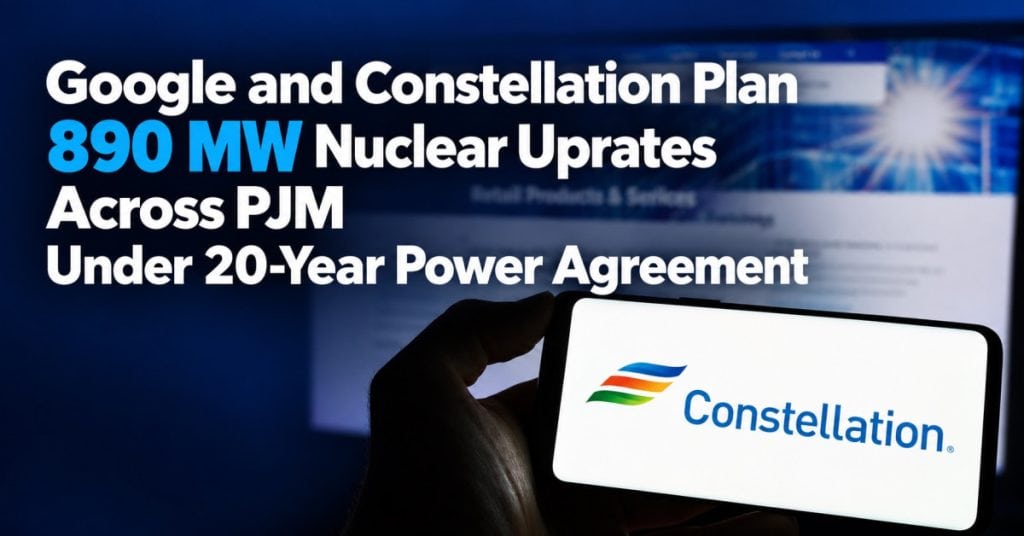
The 20-year agreement supports planned nuclear uprates at 11 operating units in Illinois, Pennsylvania and New Jersey; Constellation said the first additional capacity is expected in 2028.
Published by Allstream Insiders
Allstream Insiders Summary
Google and Constellation have announced a 20-year power purchase agreement designed to support up to 890 megawatts of planned additional nuclear generating capacity within the PJM Interconnection. According to the companies’ October 6, 2026, announcement, Constellation plans to invest in new equipment and technology at 11 company-owned nuclear units in Illinois, Pennsylvania and New Jersey. The companies said the first uprate is expected in 2028.
Constellation said it expects to make more than $4.3 billion of new investment associated with the program. It also said the work is expected to sustain approximately 4,400 existing jobs and create approximately 7,200 construction jobs across six nuclear sites in the three states.
The announcement includes a separate 15-year agreement for 2,700 MW from Constellation’s existing PJM nuclear fleet. That second agreement concerns continued energy and capacity from existing assets; it is not an additional 2,700 MW of newly created generating capacity.
Google and Constellation Nuclear Agreement at a Glance
| Item | Company-reported detail |
|---|---|
| Planned incremental capacity | Up to 890 MW of additional nuclear capacity for the PJM grid |
| Assets covered by the uprate program | 11 Constellation-owned nuclear units across Illinois, Pennsylvania and New Jersey |
| First additional capacity | Expected in 2028 |
| Company-stated investment | More than $4.3 billion |
| New-capacity agreement | 20-year power purchase agreement |
| Separate existing-fleet agreement | 15-year agreement covering 2,700 MW from existing PJM nuclear assets |
What Constellation says the nuclear uprates would involve
The announced program is directed at existing nuclear generating units, rather than a new nuclear-plant development. The companies said the planned investments would include new equipment and technology, citing turbines, steam generators and digital control systems among the categories of work.
The announcement does not identify the individual nuclear sites or units selected for each upgrade, nor does it allocate the 890 MW among the 11 units. It also does not disclose equipment suppliers, engineering firms, construction contractors, project budgets by site or outage schedules. The announcement therefore supports the stated program scope, but not conclusions about individual work packages or awards.
Why the 890 MW and 2,700 MW figures should be read separately
The 890 MW figure refers to planned incremental capacity from the announced uprate program. Under the 20-year agreement, Google is supporting Constellation’s investment in the additional capacity, which the companies said would be made available to the PJM grid.
Separately, the companies announced a 15-year agreement for 2,700 MW from Constellation’s existing PJM nuclear fleet. That arrangement is intended to support the continued operation of existing assets and should not be added to the 890 MW as newly created capacity.
Investment, employment and timing remain company-stated expectations
Constellation said the program represents more than $4.3 billion of new investment and is expected to sustain approximately 4,400 existing jobs while creating approximately 7,200 construction jobs. The companies placed those construction jobs across six nuclear sites in Illinois, Pennsylvania and New Jersey.
The reported 2028 date applies to the first expected uprate. The companies did not provide a full unit-by-unit completion schedule or state when the entire 890 MW of planned incremental capacity would be in service. Timing, investment and employment figures should therefore be read as announced expectations rather than completed results.
Technology collaboration extends beyond the power agreement
The companies also announced a five-year technology alliance involving Google Cloud and Gemini Enterprise. They said the initial areas of collaboration include engineering, permitting and interconnection planning; asset-health, outage and turnaround management; and operational-technology cybersecurity.
In addition, Google and Constellation said they plan to evaluate potential future generation, storage and demand-response opportunities across the United States. No specific future facility, location, capacity, investment decision or construction schedule was announced under that framework.
Allstream perspective: existing nuclear assets are the disclosed delivery path
The central infrastructure element is an announced uprate program at operating nuclear units, paired with a long-term agreement intended to support 890 MW of additional capacity for PJM. That distinguishes the announcement from a proposal for a new nuclear site while still identifying a substantial potential addition of firm generating capacity.
For the power-infrastructure market, site-specific execution visibility remains limited. The announcement does not identify unit-level scopes, equipment packages, contractors, procurement processes or detailed delivery dates. Until those items are disclosed, the program should be tracked as a company-announced investment and capacity plan—not as evidence of awarded work or completed capacity additions.