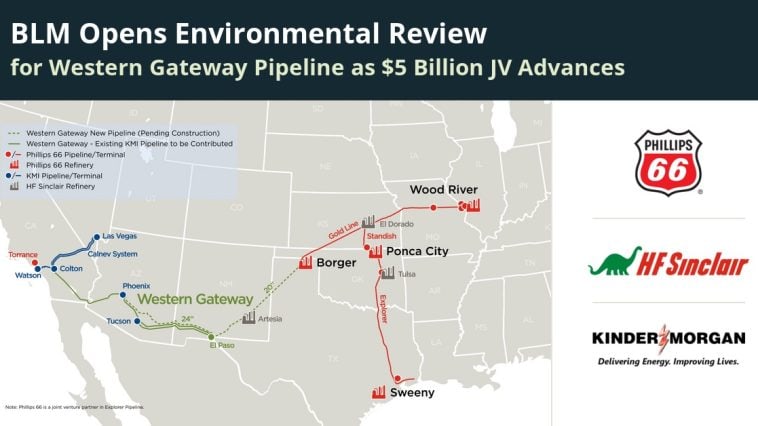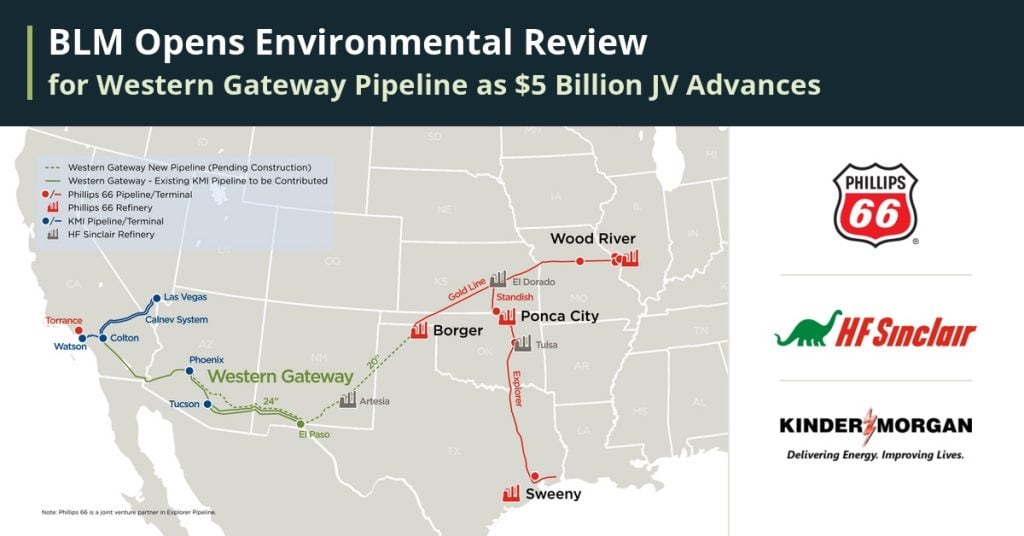
Phillips 66 is seeking a 30-year federal right-of-way for an approximately 887-mile new-build refined-products pipeline segment between Borger, Texas, and Buckeye, Arizona, following the Western Gateway joint venture’s August final investment decision.
Published by Efrain Garcia, Editor in Chief- Allstream Insiders
Allstream Insiders Summary
The Bureau of Land Management has begun the environmental-impact-statement process for the proposed Western Gateway Pipeline, a permitting milestone for the Phillips 66, Kinder Morgan and HF Sinclair joint venture.
According to the BLM’s November announcement, Phillips 66 is seeking a 30-year right-of-way for approximately 887 miles of new refined-products pipeline construction between Borger, Texas, and Buckeye, Arizona. About 170 miles of the proposed route would cross BLM-administered land in Arizona and New Mexico.
The environmental review follows the partners’ August 2026 final investment decision for the broader Western Gateway system. It is not a new final investment decision, construction notice to proceed or contractor-award announcement. The BLM’s public scoping period remains open through December 17, 2026.
A permitting milestone for the previously announced system
The BLM is evaluating Phillips 66’s application for the new-build portion of Western Gateway under the National Environmental Policy Act. The agency’s review covers the requested right-of-way and associated facilities on federal land, including access roads, pump stations, mainline valve stations and breakout facilities.
The BLM describes the proposed new-build segment as approximately 887 miles, while the joint-venture partners describe the larger Western Gateway system as approximately 1,300 miles. The difference reflects the broader project’s use of existing Kinder Morgan pipeline infrastructure, pipeline reversals and other connections beyond the new construction segment now under federal review.
The BLM’s initial schedule identifies February 2028 for publication of a final environmental impact statement and May 2028 for a record of decision. Those are agency planning dates, not guarantees that a right-of-way will be granted or that construction will begin on those dates.
Pipeline scope, size and route
Western Gateway is designed to move refined products including gasoline and diesel from Midcontinent and Gulf Coast supply areas to Arizona and California markets.
| Disclosed item | Detail |
|---|---|
| New-build pipeline | Approximately 887 miles in the BLM right-of-way application; approximately 900 miles in the joint-venture announcement |
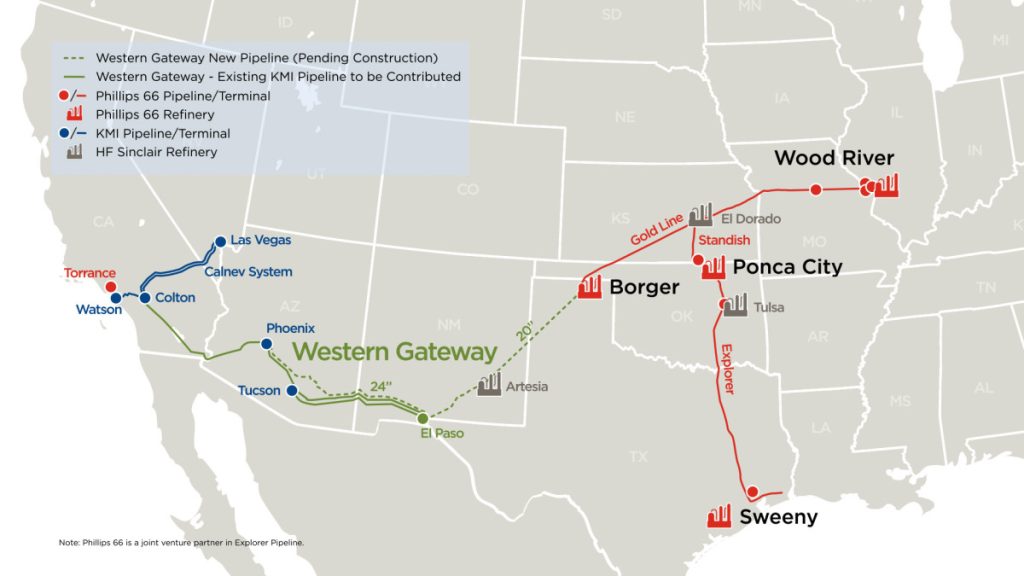
| Pipe sizes | 20-inch pipeline from Borger to El Paso, Texas; 24-inch pipeline from El Paso to Buckeye/Phoenix, Arizona |
| Design capacity | 230,000 barrels per day |
| Federal-land segment | Approximately 170 miles on BLM-administered land |
| Ancillary facilities identified by BLM | Access roads, pump stations, mainline valve stations and breakout facilities |
| Target completion | 2029, subject to permits and regulatory approvals |
The proposed route would create a new supply path from Borger through El Paso and into Arizona, connecting with existing assets that could extend deliveries toward California and other Western markets.
What each Western Gateway partner has disclosed
The partners finalized their joint-venture agreement and announced their final investment decision on August 11. Ownership is structured as 49.9% Phillips 66, 35.1% Kinder Morgan and 15.0% HF Sinclair.
Phillips 66 is the BLM right-of-way applicant and has disclosed that it will construct and operate the new-build 20-inch and 24-inch pipeline from Borger to Phoenix. Phillips 66 also plans to reverse its existing Gold Pipeline so refined products can move toward Borger from the St. Louis direction and supply Western Gateway.
Kinder Morgan will contribute its existing SFPP East Line from El Paso to Phoenix and Tucson, along with its SFPP West Line from Colton, California, to Phoenix. The SFPP West Line is planned for reversal to support east-to-west product movement into California. Kinder Morgan has said it will continue operating those existing pipelines.
HF Sinclair is an equity partner in the joint venture and has committed capital to the project. The joint announcement does not assign HF Sinclair a separate construction or operating scope for the new-build pipeline, SFPP lines or Gold Pipeline reversal.
The companies placed the system’s enterprise value at approximately $5 billion. They disclosed planned cash contributions of approximately $2.5 billion from Phillips 66, $750 million from HF Sinclair and $250 million from Kinder Morgan, in addition to Kinder Morgan’s contribution of existing SFPP assets valued at approximately $1.5 billion.
Refined-product origin points disclosed to date
The companies have described Western Gateway as connecting Midcontinent and Gulf Coast refined-product supplies to Arizona and California.
Disclosed supply areas include:
- Midcontinent refinery supply;
- Illinois refinery supply moving toward Borger through a reversed Gold Pipeline;
- Houston-area supply;
- Port Arthur/Beaumont-area supply; and
- expanded Gulf Coast origin points.
The disclosures identify these supply regions and transportation paths, but they do not allocate volumes by individual refinery, name a committed refinery supply contract, or establish which refinery will supply a given shipment. The project should therefore not be characterized as a dedicated pipeline for any one refinery.
What the permitting stage could mean for industry
If Western Gateway receives the required authorizations and proceeds into field execution, its disclosed scope could create demand for refined-products-pipeline engineering, survey and environmental services; line pipe; fittings; mainline and station valves; pumping equipment; motors; electrical systems; controls and SCADA equipment; meter and measurement systems; and communications infrastructure.
Construction could also involve right-of-way preparation, civil work, roads and drainage, trenching, welding, nondestructive examination, horizontal directional drilling or other crossing methods, coating, hydrostatic testing, inspection, restoration, equipment rentals and field-support services.
Those are potential requirements for a project of this type—not announced procurement packages, contractor awards or confirmed supply opportunities.
Allstream perspective: FID has been made; federal review remains material
Allstream perspective: Western Gateway’s August final investment decision established the partners’ intention to advance the project. The BLM’s environmental review is the next material public milestone for the new-build segment crossing federal land.
The new disclosure provides greater definition around the right-of-way application, construction corridor and associated facilities, but it does not establish that all permits are in hand or that construction has started. Contractors and suppliers should watch for the final environmental-review outcome, right-of-way decision, detailed routing, project execution updates and future award announcements.