Allstream Insiders Summary
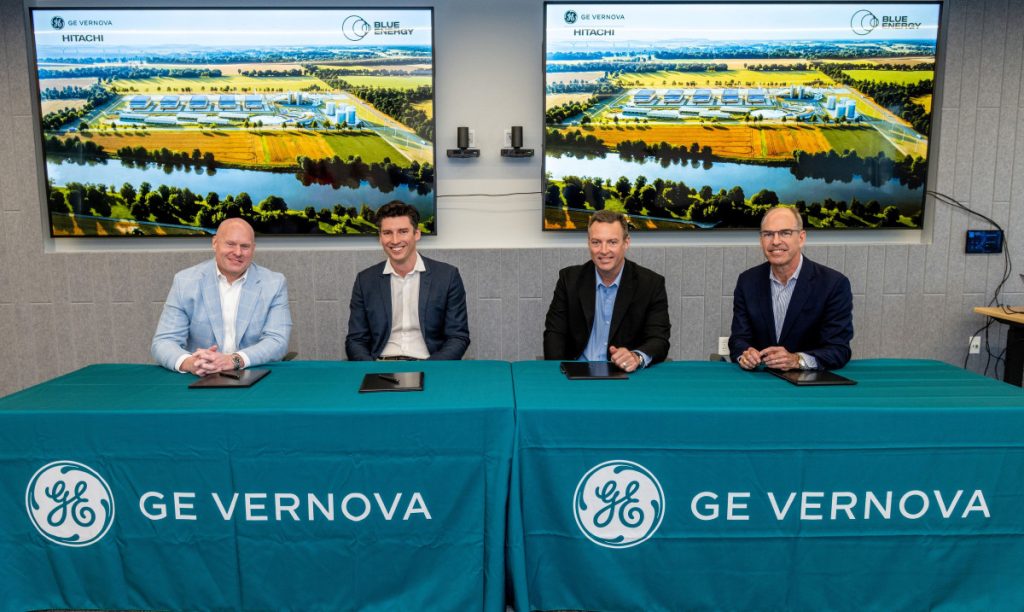
Blue Energy and GE Vernova Hitachi Nuclear Energy have signed an agreement to advance engineering design, licensing and safety analysis for a proposed 2.5-gigawatt gas-plus-nuclear power project in Victoria, Texas. The project remains subject to a final investment decision targeted for 2027.
Blue Energy’s phased plan calls for two GE Vernova 7HA.02 gas turbines to initially supply approximately 1 gigawatt of power in 2030. The developer then plans to add approximately 1.5 gigawatts of nuclear generation from as many as five GE Vernova Hitachi BWRX-300 small modular reactors beginning in 2032.
The companies previously signed a slot-reservation agreement for delivery of the two gas turbines in 2029. The August 13 agreement moves the nuclear portion into more detailed development work but does not represent a final investment decision, construction authorization or a full engineering, procurement and construction award.
Blue Energy plans to use the power for a nearby artificial-intelligence data center. Crusoe separately identified itself as Blue Energy’s data center partner and has described a planned 1,600-acre campus in Calhoun County near the Port of Victoria power site.
Victoria Gas-Plus-Nuclear Project Tracker
| Project component | Confirmed scope | Current stage | Target schedule |
|---|---|---|---|
| Natural-gas generation | Two GE Vernova 7HA.02 gas turbines providing approximately 1 gigawatt | Turbine slot-reservation agreement signed; overall project remains subject to final investment decision | Turbine delivery targeted for 2029; power targeted in 2030 |
| Nuclear generation | Up to five BWRX-300 small modular reactors providing approximately 1.5 gigawatts | Engineering design, licensing and safety analysis advancing | Construction-permit application planned for 2027; nuclear generation planned to begin in 2032 |
| Overall generation project | Strategically paired natural-gas and nuclear capacity totaling approximately 2.5 gigawatts | Development and pre-licensing | Final investment decision targeted for 2027 |
| Associated AI data center | Crusoe-developed campus on approximately 1,600 acres in nearby Calhoun County | Announced development | Expected to receive power from the phased generation project |
What Did the New Agreement Change?
The August agreement advances the proposed nuclear plant from a strategic collaboration into defined engineering, licensing and safety-analysis work. GE Vernova’s May announcement established the 2.5-gigawatt gas-plus-nuclear concept, identified the Texas project and reserved manufacturing slots for two gas turbines. The new agreement names Victoria as the project location and authorizes the next phase of technical development with GE Vernova Hitachi Nuclear Energy.
This work is expected to develop the information needed for Blue Energy’s planned nuclear construction-permit application. The U.S. Nuclear Regulatory Commission lists Blue Energy in pre-application engagement for a future construction-permit application. NRC staff has found two Blue Energy topical reports—BE-QAPD-001 covering the quality-assurance program and BE-BOPTR-02 addressing the proposed sequencing of balance-of-plant and nuclear-island construction—acceptable for referencing in future licensing applications, subject to the limitations and conditions in their respective safety evaluations.
Those NRC acceptances are licensing milestones, but they do not authorize construction or operation of the proposed Victoria reactors. The project remains subject to site-specific review, a final investment decision and additional regulatory authorizations before nuclear construction can proceed.
How Would the Gas-Plus-Nuclear Development Work?
Blue Energy plans to establish approximately 1 gigawatt of gas-fired generation first, then add approximately 1.5 gigawatts of nuclear generation as the BWRX-300 units enter service. The two 7HA.02 gas turbines are reserved for delivery in 2029, with the initial power block targeted to serve the nearby data center in 2030.
Beginning in 2032, Blue Energy plans to add as many as five BWRX-300 reactors. Each reactor is designed for approximately 300 megawatts of generation, producing the stated 1.5-gigawatt nuclear total if all five units are developed.
The phrase “gas plus nuclear” describes a phased development strategy; it does not mean the natural-gas turbines will be converted into nuclear reactors. The gas turbines and BWRX-300 reactors are distinct technologies within Blue Energy’s phased development plan. The public disclosures do not yet fully define how their steam-cycle, balance-of-plant or operating arrangements would be integrated. Blue Energy’s objective is to provide power from gas generation while the nuclear portion moves through licensing, fabrication and construction.
The latest release says the nuclear capacity would be added to the initial gas-fired supply. Actual operating configuration, dispatch and the timing of each reactor would depend on final design, permits, commercial arrangements and future investment decisions.
Where Is the Project Planned?
Blue Energy is advancing the 2.5-gigawatt project in Victoria, Texas. Separately, the Victoria County Navigation District said it granted Blue Energy an option to lease approximately 70 acres at the Port of Victoria’s Texas Logistics Center for a potential modular nuclear facility. The public announcements do not assign the entire gas-plus-nuclear scope to that 70-acre nuclear parcel.
Crusoe said its Calhoun County campus was selected for its existing infrastructure, proximity to transmission and fiber networks, and access to natural-gas infrastructure. Separately, Blue Energy’s proposed construction model contemplates off-site fabrication and barge transportation, making the Port of Victoria location relevant to its module-delivery strategy.
The associated data center is a separate nearby development. Crusoe’s October 2025 announcement places its planned 1,600-acre artificial-intelligence campus in Calhoun County, while the Blue Energy power project is associated with the Port of Victoria site. Keeping those locations distinct avoids incorrectly placing both developments on the same parcel or in the same county.
What Is Blue Energy’s Prefabricated Construction Strategy?
Blue Energy plans to move a significant portion of plant fabrication away from the final site and into controlled manufacturing environments. The company calls its integrated prefabrication, transportation and assembly method the “Blue Way.”
The approach is designed around the standardized BWRX-300 and includes off-site fabrication, logistics planning and large-module assembly. Blue Energy says its proposed construction model draws from techniques used in the offshore oil and gas, liquefied natural gas and wind sectors and contemplates fabrication in existing shipyards with large modules transported by barge.
For industrial suppliers, the approach could shift portions of the nuclear construction program toward qualified fabrication yards, module integrators, heavy-transport providers and marine logistics companies. The August release does not identify the fabrication yards, transportation contractors or site-construction contractors that would perform those scopes.
Which Companies Have Confirmed Roles?
Blue Energy, GE Vernova, GE Vernova Hitachi and Crusoe have publicly identified roles in the generation and data-center development. Their current responsibilities include:
- Blue Energy: project development, financing strategy, licensing coordination and the prefabricated plant-delivery model
- GE Vernova: two reserved 7HA.02 gas turbines for the initial approximately 1-gigawatt power block
- GE Vernova Hitachi Nuclear Energy: BWRX-300 reactor technology and the newly authorized engineering-design, licensing and safety-analysis work
- Crusoe: development of the nearby artificial-intelligence data center campus intended to receive power from the project
- Port of Victoria: option agreement covering approximately 70 acres at the Texas Logistics Center for a potential modular nuclear facility
The agreement does not support describing any company as the full engineering, procurement and construction contractor for the entire 2.5-gigawatt development. It also does not confirm awards for civil construction, electrical balance of plant, gas supply, transmission, reactor module fabrication or commissioning.
What Are the Next Project Milestones?
The most important near-term milestones are completion of the current engineering and safety work, a planned 2027 construction-permit application and the targeted 2027 final investment decision. Those steps will determine whether Blue Energy can move from development into committed execution.
The announced schedule includes:
- Continued site characterization, engineering design, licensing and safety analysis
- A nuclear construction-permit application targeted for 2027
- A project final investment decision targeted for 2027
- Delivery of two 7HA.02 gas turbines targeted for 2029
- Approximately 1 gigawatt of initial gas-fired power targeted for 2030
- Nuclear generation from up to five BWRX-300 reactors planned to begin in 2032
The 2032 nuclear milestone refers to the planned beginning of reactor generation, not necessarily simultaneous completion of all five units. The release does not provide a unit-by-unit startup sequence.
Allstream Perspective
The Victoria development could create two overlapping power-construction programs: a near-term gas-fired generation block and a longer-duration modular nuclear buildout. The newly signed agreement is most significant because it begins the technical work needed to define the nuclear scope and support licensing.
If the project reaches final investment decision, the announced technologies and proposed delivery approach could support work involving:
- Gas-turbine foundations, setting, auxiliaries and balance-of-plant systems
- Natural-gas supply, metering and interconnection infrastructure
- Heat-recovery, steam-cycle and cooling systems, depending on final plant design
- Nuclear-island engineering and safety-related systems
- Off-site module fabrication and quality-controlled manufacturing
- Marine transport, heavy haul, lifting and module assembly
- Electrical substations, transmission interconnections and protection systems
- Water, wastewater, fire protection, security and site utilities
- Testing, startup and commissioning for both generating technologies
These categories are Allstream analysis based on the announced technologies and delivery strategy. They are not confirmed bid packages, solicitations or contractor awards.
The project should still be treated as a proposed development. The gas-turbine reservation gives the initial power block a meaningful equipment milestone, while the new GE Vernova Hitachi agreement advances nuclear engineering and licensing. Neither step replaces the 2027 final investment decision or the regulatory approvals required before full construction.