EIA preliminary data show rapid utility-scale battery deployment, but the federal inventory excerpt does not identify individual projects, owners, budgets or technology specifications.
Published by Allstream Insiders
Allstream Insiders Summary
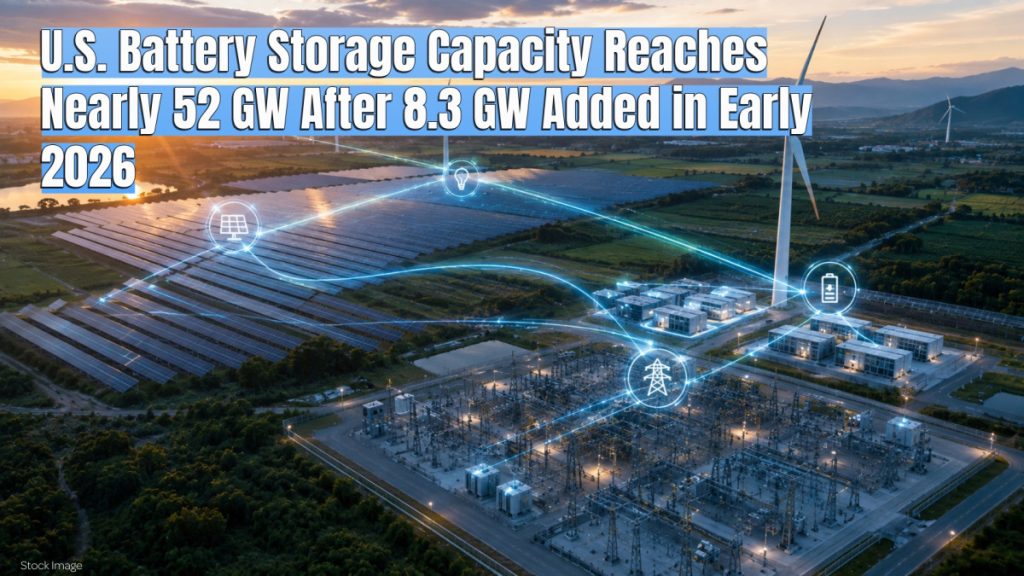
U.S. utility-scale battery storage reached nearly 52 gigawatts (GW) of nameplate capacity after operators added 8.3 GW during the first six months of 2026, according to the U.S. Energy Information Administration (EIA). The agency’s preliminary generator inventory follows 43.6 GW of operational battery storage capacity at the end of 2025.
The national figures establish the scale and pace of battery deployment, but they are not a list of project awards or construction opportunities. The EIA excerpt does not identify the individual facilities, operators, owners, locations, budgets, contractors, technology configurations or exact completion dates represented by the additions.
What changed in U.S. battery storage capacity?
Operators added 8.3 GW of battery storage capacity during the first half of 2026, taking the U.S. total to nearly 52 GW of nameplate capacity, EIA reported on August 7, 2026. The agency based its update on the Preliminary Monthly Electric Generator Inventory.
EIA also reported that utility-scale battery storage capacity grew at an average annual rate of 70% over the preceding three years. At the end of 2025, the U.S. power system had 43.6 GW of operational battery storage capacity.
The source uses two related but distinct descriptions: “operational” capacity for the year-end 2025 figure and “nameplate” capacity for the total reached during the first six months of 2026. Those terms should not be treated as additional project-stage detail beyond what EIA disclosed.
| Reporting point | EIA-reported U.S. battery storage figure | Description in source |
|---|---|---|
| End of 2025 | 43.6 GW | Operational battery storage capacity |
| First six months of 2026 | 8.3 GW added | Battery storage capacity added by operators |
| After first-half 2026 additions | Nearly 52 GW | Nameplate battery storage capacity |
| Preceding three years | 70% average annual growth | Utility-scale battery storage capacity growth |
What project details remain undisclosed?
The EIA excerpt reports an aggregate national capacity update rather than project-level development information. It does not disclose:
- Individual battery energy storage system names or operators
- State, county or site locations for the additions
- Ownership or customer identities
- Capital expenditure, project budgets or contract values
- Engineering, procurement and construction contractors
- Battery chemistry, duration, power-conversion equipment or other technical specifications
- Exact completion or commercial-operation dates for individual facilities
- Project-specific regulatory or interconnection status
Accordingly, the 8.3 GW addition cannot be assigned to a particular developer, market, contractor or equipment supplier based on this source alone. It also should not be interpreted as a disclosed procurement pipeline or a project-specific capital program.
Allstream analysis: What the national capacity increase signals
Allstream analysis: The EIA data provide a high-level measure of how quickly utility-scale battery infrastructure is entering the U.S. power system. An additional 8.3 GW in six months is commercially relevant to companies serving battery facilities and their grid connections, but the aggregate figure does not establish which projects remain available for bidding or which scopes have already been contracted and completed.
For EPC firms, equipment manufacturers, automation providers, inspectors and industrial-service companies, actionable opportunity assessment would require project-level records covering location, development stage, interconnection progress, ownership, technology and procurement status. None of those fields is available in the supplied EIA excerpt.
The update is therefore best used as a national deployment benchmark. It documents the expansion of U.S. battery storage capacity while leaving the composition of the first-half 2026 additions—and any associated contracting activity—unresolved.