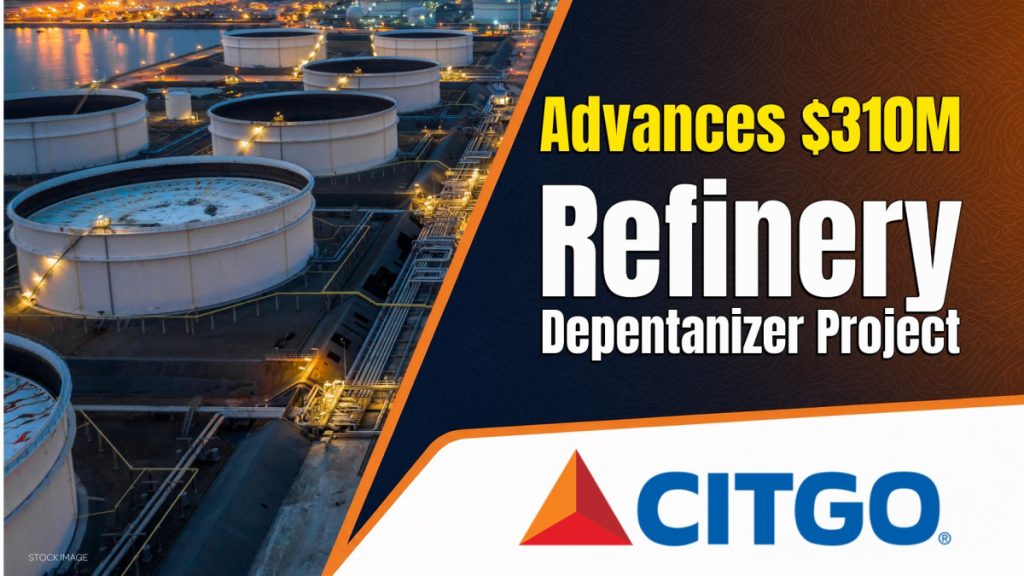

The refinery investment will add facilities and equipment to upgrade naphtha streams into gasoline blend components, with operations expected in 2029.
Published by Allstream Insiders
Allstream Insiders Summary
CITGO Petroleum Corporation is advancing a $310 million Depentanizer Project at its Lake Charles Refinery in Louisiana. The project will add facilities and equipment designed to improve naphtha upgrading by converting lower-value refinery streams into higher-value gasoline blend components.
CITGO expects the project to be operational in 2029. The company says the investment is intended to increase refinery flexibility, support the processing of domestic light crude and produce additional gasoline components.
The September 1 announcement also states that the project will create additional contract work during construction and extend opportunities to local suppliers and service providers. CITGO did not identify an engineering, procurement and construction contractor, specific bid packages or a construction-start date in the release.
CITGO Lake Charles Depentanizer Project Overview
| Project item | Company-reported detail |
|---|---|
| Project | Lake Charles Refinery Depentanizer Project |
| Location | Lake Charles, Louisiana, along the Calcasieu Ship Channel |
| Investment | $310 million |
| Scope | New facilities and equipment for naphtha upgrading and production of gasoline blend components |
| Project status | CITGO says the project is advancing |
| Expected operations | 2029 |
| Named work phases | Engineering, construction and commissioning |
What is CITGO building at the Lake Charles Refinery?
CITGO plans to install new facilities and equipment that improve the refinery’s naphtha-upgrading capabilities. According to the company, the Depentanizer Project will convert lower-value streams into higher-value components used in gasoline blending.
The project is intended to give the refinery additional operating flexibility and improve its ability to process domestic light crude. CITGO links the investment to the production of additional gasoline components and continued U.S. transportation-fuel demand.
CITGO Executive Vice President and Chief Operating Officer Edgar Rincon described the development as an investment intended to strengthen the company’s refining system. The announcement does not assign a new barrels-per-day capacity figure to the depentanizer or state that the project will increase the refinery’s rated crude-processing capacity.
Why is the Lake Charles location important?
The Lake Charles facility is CITGO’s largest refinery and has a current company-listed refining capacity of 479,000 barrels per day. The refinery began operating in 1944 and produces gasoline, diesel, jet fuel, petrochemicals and other products.
Its location on the Calcasieu Ship Channel gives the site marine access, while pipelines and other logistics systems connect the refinery to crude supply and refined-product markets. CITGO says the existing configuration allows the refinery to process a diverse slate of crude oils.
The Depentanizer Project is an upgrading investment within that established refining complex. Based on CITGO’s description, the project’s stated purpose is to improve product conversion and flexibility rather than establish a separate refinery or standalone fuels facility.
When will the Depentanizer Project enter operation?
CITGO expects the project to be operational in 2029. The date is a company target and remains subject to project execution, construction and commissioning.
CITGO said it will continue working with employees, contractors and local stakeholders as engineering, construction and commissioning activities advance. The release does not divide the $310 million investment among those phases or provide interim engineering, procurement or physical-construction percentages.
What does the project mean for contractors and suppliers?
CITGO expressly states that the investment will create additional contract work during construction and opportunities for local suppliers and service providers. That language confirms an expected supply-chain component, but it does not constitute a solicitation or identify the scope, timing or value of individual contracts.
For companies following the development, the verified activity phases are engineering, construction and commissioning. Any more detailed assessment of civil, mechanical, electrical, instrumentation, equipment or specialty-service requirements should wait for CITGO, its selected contractors or procurement representatives to issue project-specific information.
Allstream perspective: a defined refinery investment with a multi-year execution window
The $310 million capital value and 2029 operating target make the Depentanizer Project a material downstream development for Southwest Louisiana. Unlike a general corporate capital plan, the announced value is tied directly to a named project at a specific refinery.
The most useful near-term signals for the industrial supply chain will be formal contractor selections, procurement notices, major equipment commitments and confirmation of field-construction milestones. Until those details are announced, the defensible opportunity statement is the one CITGO has made: the project is expected to generate additional contract work during construction and extend opportunities to local suppliers and service providers.