Industrial Dehumidification: Why It Matters More Than Ever
Industrial facilities face a constant battle against moisture. Whether it’s a refinery turnaround, LNG facility construction project, petrochemical maintenance outage, power generation upgrade, offshore platform coating application, or hyperscale data center construction, excess humidity can lead to costly delays, corrosion, coating failures, equipment damage, and safety concerns.
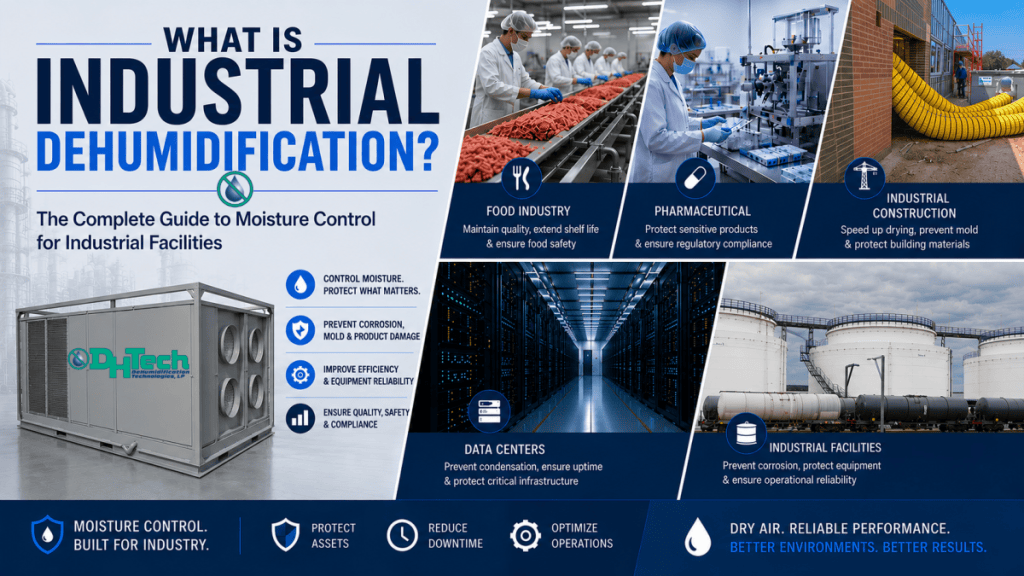
Industrial dehumidification is the process of controlling humidity levels and removing moisture from the air to create optimal environmental conditions for construction, maintenance, preservation, coating applications, equipment storage, and operational reliability.
As industries continue investing billions of dollars into new infrastructure, maintaining proper environmental conditions has become a critical component of project success.
What Is Industrial Dehumidification?
Industrial dehumidification involves the use of specialized equipment designed to remove moisture from the air within large industrial environments. Unlike residential dehumidifiers, industrial dehumidification systems are engineered to manage large volumes of air, achieve precise humidity targets, and operate continuously in demanding environments.
The primary objective is to maintain specific relative humidity (RH) and dew point conditions that support:
- Corrosion prevention
- Surface preparation and coating applications
- Equipment preservation
- Product quality control
- Worker safety
- Regulatory compliance
- Construction and commissioning activities
Industrial dehumidification systems are commonly deployed in:
- Oil and gas facilities
- Refineries
- Petrochemical plants
- LNG export terminals
- Chemical manufacturing facilities
- Power generation plants
- Offshore platforms
- Marine environments
- Data centers
- Pharmaceutical facilities
- Food processing operations
- Storage tanks and vessels
How Industrial Dehumidification Works
Industrial dehumidification systems remove water vapor from the air before it can condense on equipment, surfaces, or materials.
The most common technology used in industrial applications is desiccant dehumidification.
Desiccant Dehumidification
Desiccant systems utilize a specialized moisture-absorbing material that captures water vapor as air passes through the unit.
The process typically includes:
- Moist air enters the dehumidifier.
- Moisture is absorbed by the desiccant wheel.
- Dry air is discharged into the work area.
- The desiccant is regenerated through a separate heated airflow.
- Moisture is exhausted outside the controlled environment.
This process allows facilities to achieve extremely low humidity levels, even in challenging environments where traditional refrigeration-based systems are ineffective.
Relative Humidity vs. Dew Point: Understanding the Difference
One of the most common questions asked by project managers, inspectors, and maintenance professionals is:
What is Relative Humidity?
Relative humidity measures the amount of moisture in the air compared to the maximum amount the air can hold at a given temperature.
- 100% RH = Air is fully saturated
- 50% RH = Air contains half the moisture it can hold
- Below 40% RH = Conditions where corrosion rates are significantly reduced
What is Dew Point?
Dew point is the temperature at which moisture begins to condense into liquid water.
Dew point control is critical during:
- Industrial painting projects
- Tank maintenance
- Vessel preservation
- Pipeline construction
- Equipment commissioning
When surfaces fall below the dew point temperature, condensation forms, creating conditions for flash rusting, coating failures, and corrosion.
Why Humidity Control Is Critical in Industrial Facilities
Corrosion Prevention
Corrosion costs industries billions of dollars annually.
Research has shown that corrosion rates increase dramatically when relative humidity rises above approximately 60%.
By maintaining humidity levels below critical thresholds, facilities can:
- Extend equipment life
- Reduce maintenance costs
- Protect critical infrastructure
- Improve reliability
Coating and Painting Success
Industrial coatings require precise environmental conditions.
Excess humidity can cause:
- Blistering
- Delamination
- Poor adhesion
- Premature coating failure
Many coating manufacturers specify humidity and dew point requirements that must be maintained throughout surface preparation, application, and curing.
Equipment Preservation
Generators, turbines, compressors, pumps, motors, and electrical equipment are all vulnerable to moisture damage.
Dehumidification protects:
- Electrical systems
- Rotating equipment
- Instrumentation
- Control systems
- Spare parts inventories
Construction and Commissioning
During construction and startup phases, moisture can impact:
- Concrete curing
- Electrical installations
- Equipment storage
- Insulation systems
- Building materials
Maintaining proper humidity conditions helps prevent delays and improves project quality.
Industrial Dehumidification Applications
Refinery Turnarounds
Refinery maintenance turnarounds often involve vessel entry, tank inspections, coating projects, and equipment preservation. Industrial dehumidification helps reduce downtime while protecting assets during maintenance activities.
Petrochemical Facilities
Petrochemical plants frequently require humidity control during shutdowns, mechanical maintenance, equipment storage, and corrosion mitigation programs.
LNG Export Facilities
LNG projects utilize dehumidification for construction activities, insulation protection, equipment preservation, and commissioning support.
Power Generation Facilities
Power plants rely on humidity control to protect turbines, generators, electrical systems, boilers, and critical infrastructure.
Data Centers
The explosive growth of artificial intelligence and cloud computing has accelerated hyperscale data center construction worldwide.
Dehumidification supports:
- Environmental control during construction
- Electrical equipment protection
- Building commissioning
- Moisture management during startup
Storage Tanks and Vessels
Industrial dehumidification is commonly used for tank drying, hydrotest drying, vessel preservation, internal inspections, and coating applications.
Tank Drying After Hydrotesting
One of the most common industrial applications is tank and vessel drying following hydrostatic testing.
After hydrotesting, residual moisture can create ideal conditions for corrosion.
Industrial dehumidification accelerates drying while helping facilities:
- Meet project schedules
- Protect asset integrity
- Improve coating performance
- Reduce rework
For large tanks and vessels, dehumidification often provides the most efficient and reliable drying solution available.
Industrial Dehumidifier Rental vs. Purchase
Many facilities choose rental solutions because industrial dehumidification needs are often project-based.
Rental solutions provide:
- Immediate availability
- Reduced capital expenditures
- Access to the latest technology
- Engineering support
- Flexible deployment options
- Scalability for projects of any size
Frequently Asked Questions About Industrial Dehumidification
What Relative Humidity Prevents Corrosion?
Many facilities target humidity levels below 40% RH to significantly reduce corrosion risk.
How Long Does It Take to Dry a Storage Tank?
Drying times depend on tank size, temperature, initial moisture levels, airflow rates, and humidity targets.
What Is the Difference Between Desiccant Dehumidifiers and Refrigerant Dehumidifiers?
Desiccant systems are designed for industrial environments and can achieve significantly lower humidity levels than traditional refrigerant units.
Why Is Dew Point Important for Industrial Coatings?
Coatings applied when surface temperatures approach the dew point are more likely to experience adhesion problems, premature failure, and corrosion-related issues.
Can Industrial Dehumidification Reduce Project Delays?
Yes. Proper humidity control helps improve coating performance, accelerate drying, protect equipment, and create more predictable project schedules.
The Future of Industrial Moisture Control
As industrial facilities become increasingly complex and project schedules become more demanding, industrial dehumidification is evolving from a specialized environmental control service into a critical component of project execution, risk management, and operational reliability.
From multi-billion-dollar LNG export terminals and petrochemical complexes to power generation facilities, pharmaceutical manufacturing plants, food processing operations, and AI-driven data centers, humidity control is becoming a standard requirement for successful construction, maintenance, preservation, coating applications, equipment storage, and long-term asset protection.
Organizations that proactively manage moisture gain significant advantages through improved asset reliability, reduced downtime, enhanced worker safety, greater regulatory compliance, and more predictable project schedules. As capital projects continue to grow in size and complexity, industrial dehumidification is no longer viewed as an optional service—it is increasingly recognized as a strategic investment that helps protect critical assets, improve project outcomes, and reduce overall lifecycle costs.
Why Choose Dehumidification Technologies (DH Tech)?
For several decades, Dehumidification Technologies (DH Tech) has helped some of the world’s leading industrial organizations solve complex humidity control challenges across refineries, petrochemical facilities, LNG terminals, power generation plants, offshore platforms, marine facilities, manufacturing operations, storage terminals, and rapidly growing data center developments.
Backed by a leadership team with several decades of industry experience each, DH Tech understands the operational realities, project pressures, and environmental challenges faced by industrial owners, EPC contractors, maintenance organizations, and construction teams.
More than simply an industrial dehumidifier rental provider, DH Tech delivers engineered moisture control solutions that help protect critical assets, improve reliability, accelerate project schedules, support successful turnarounds, and reduce costly downtime.
With a global footprint spanning 13 offices worldwide, DH Tech provides responsive service, technical expertise, and industrial dehumidification solutions wherever projects are located. Whether supporting a refinery turnaround on the Gulf Coast, an LNG export facility under construction, an offshore maintenance campaign, a petrochemical expansion project, or a hyperscale AI data center development, DH Tech has the resources and experience to help clients maintain optimal environmental conditions and keep projects moving forward.
To learn more about industrial dehumidification solutions, Contact us at www.RentDH.com or Call (866)736-8348)