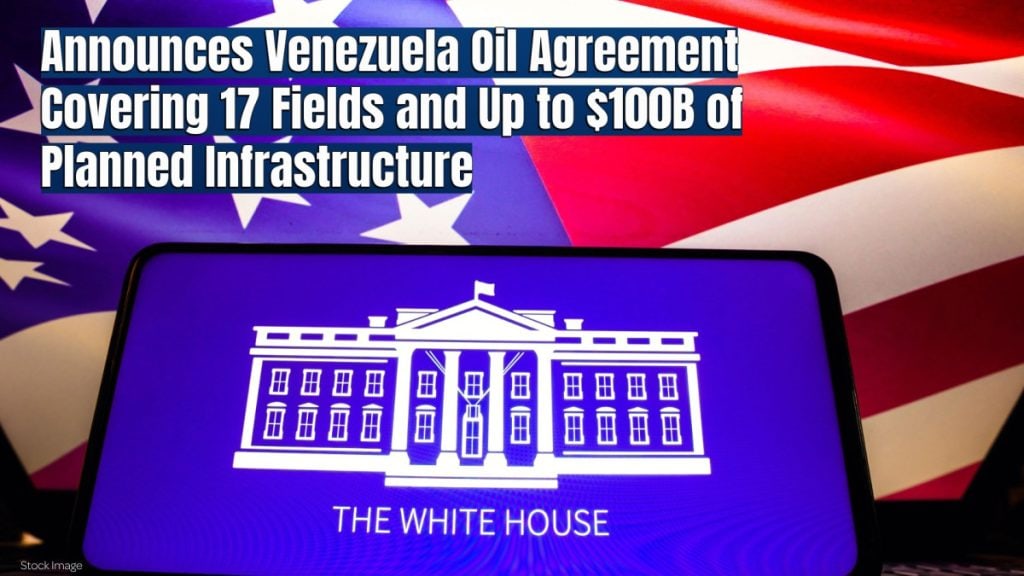
The White House says North American Blue Energy Partners received 100-year concessions covering 17 Venezuelan oil fields and plans to invest up to $100 billion in new oil infrastructure, but the government has not identified the fields or published a project-by-project execution schedule.
Published by Allstream Insiders
Allstream Insiders Summary
The White House has announced an oil agreement centered on 17 Venezuelan fields and a private-sector plan for up to $100 billion of new oil infrastructure. According to an August 31, 2026, White House fact sheet, Venezuelan interim authorities granted North American Blue Energy Partners, or NABEP, 100-year concessions covering fields with approximately 65 billion barrels of proven oil reserves.
The administration said NABEP granted the U.S. Department of War’s Office of Strategic Capital a 35% equity stake in the company’s corporate parent at no cost to the U.S. government. NABEP characterized the provision as U.S. government rights to a 35% stake. The agreement also gives the U.S. Department of State rights to purchase part of the production from NABEP-operated fields.
The announced $100 billion figure is an investment plan, not a completed expenditure or a portfolio of sanctioned construction projects. The White House materials do not identify the 17 fields, divide the investment by asset, name engineering or construction contractors, or provide a detailed development schedule.
What does the Venezuela oil agreement include?
The agreement combines long-term Venezuelan field concessions with U.S. government ownership, governance and oil-purchase rights. The White House described NABEP as a privately held operator with existing production in Venezuela.
| Agreement element | White House description |
|---|---|
| Field concessions | 100-year concessions covering 17 Venezuelan oil fields |
| Reported reserves | Approximately 65 billion barrels of proven oil reserves associated with the concessions |
| Planned infrastructure investment | Up to $100 billion, according to NABEP’s plan as described by the White House |
| U.S. government equity interest | A 35% equity stake in NABEP’s corporate parent, as described by the White House; NABEP described the provision as rights to a 35% stake |
| Guaranteed purchase right | The State Department may purchase 20% of production from current and future NABEP-operated fields at production cost |
| Additional purchase right | The State Department has a right of first refusal on the remaining 80% of production |
| Governance provisions | U.S. veto authority over board appointments and a requirement that a majority of directors be U.S. citizens |
How much oil is currently associated with the operator?
NABEP said it has increased its production from approximately 18,000 barrels per day to more than 200,000 barrels per day and has a near-term goal of exceeding 1 million barrels per day. A September 2 White House release separately described the company as already producing approximately 250,000 barrels per day. Neither public announcement includes a field-by-field reconciliation of those figures.
The administration said material production could begin reaching the United States as early as 2027 under the agreement’s purchase rights. That timing is an administration projection, not a reported in-service date for a specific development project.
The releases do not provide a field-by-field production baseline, a forecast showing how output would increase, or a schedule for individual wells, gathering systems or processing facilities.
What infrastructure could be involved?
The White House said NABEP’s plan calls for up to $100 billion of new oil infrastructure in Venezuela as the company seeks to scale production. It also said future Venezuelan output is expected to use American rigs and infrastructure and that millions of barrels could be processed by U.S. refineries.
Based solely on the development configuration described by the administration—not on announced procurement packages—the program could eventually involve work associated with:
- Drilling rigs, well construction and oilfield services
- Production equipment and field-rehabilitation programs
- Gathering systems, pipelines, pumping and storage infrastructure
- Electrical systems, instrumentation, controls and communications
- Marine transportation, terminals and crude-oil logistics
- U.S. refinery feedstock handling and processing requirements
These are potential supply-chain categories inferred from the announced development concept, not confirmed contracts, bid packages or purchasing opportunities. The White House has not disclosed a procurement calendar or contractor list.
What remains undisclosed?
The public announcements do not identify the 17 oil fields or explain how the approximately 65 billion barrels were assigned across the concession portfolio. They also do not provide independent reserve reports, executed concession instruments, development plans, financing commitments, environmental approvals, production-sharing details or capital allocation by project.
The stated investment, production and economic outcomes are forward-looking. Their realization will depend on financing, engineering, permitting, field conditions, commercial agreements, security, political conditions and execution.
Allstream perspective: a large development framework, not yet a project list
For the upstream supply chain, the announcement establishes a potentially large development framework tied to mature and underproducing Venezuelan oil assets. The scale described by the White House could become significant for drilling, field services, production equipment, pipelines, terminals and refining if NABEP advances funded projects under the concessions.
However, the announcement should not be read as evidence that $100 billion of projects has reached final investment decision or entered construction. The next commercially useful disclosures would be the names and operating status of the fields, initial development priorities, production targets, financing structure, contractor strategy and procurement schedule.