Subheadline: The agreement covers EDF power solutions’ U.S. and Canadian renewable-energy operations, including owned solar, wind and battery-storage assets and an integrated development, construction, operations and asset-management platform.
Published by Allstream Insiders.
Allstream Insiders Summary
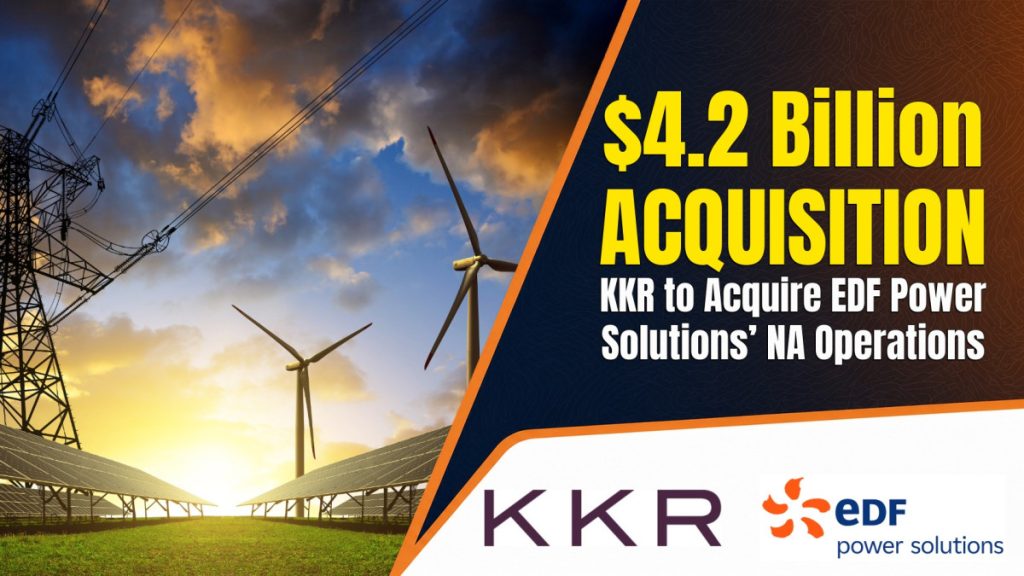
KKR has agreed to acquire the U.S. and Canadian operations and assets of EDF power solutions in a transaction valued at approximately $4.2 billion, with potential additional payments of up to $390 million. The agreement covers EDF power solutions Inc. in the United States and EDF power solutions Canada Inc.
The proposed acquisition is broader than a transfer of individual generating plants. KKR said the businesses own and operate a diversified portfolio of solar, wind and battery energy storage system (BESS) assets and operate an integrated platform spanning project development, construction, long-term operations and maintenance (O&M), and asset management.
EDF expects the sale to close in the second half of 2026, subject to required regulatory approvals. Until the transaction closes, the announcement should be treated as a signed acquisition agreement—not a completed ownership transfer.
KKR said it plans to support expansion of the platform’s asset base and acceleration of its development pipeline. Neither company disclosed a transaction-specific project list, aggregate generation capacity, development-pipeline capacity, project-level capital program or contractor awards in the June 30 announcements.
What Is Included in KKR’s EDF Power Solutions Acquisition?
The signed agreement covers EDF power solutions’ operations and assets in the United States and Canada. KKR described those businesses collectively as the company’s North American renewable operations.
| Transaction item | Confirmed detail |
|---|---|
| Buyer | KKR |
| Seller | EDF group |
| Businesses covered | EDF power solutions Inc. and EDF power solutions Canada Inc. |
| Geography | United States and Canada |
| Transaction value | Approximately $4.2 billion |
| Potential additional payments | Up to $390 million |
| Power technologies identified | Solar, wind and battery storage |
| Platform capabilities identified | Development, construction, long-term O&M and asset management |
| Transaction stage | Signed agreement; not yet closed |
| Expected closing | Second half of 2026, subject to regulatory approvals and customary closing conditions |
The public announcements do not identify every legal entity, joint venture, project interest or service contract that will transfer at closing. They also do not state that EDF power solutions’ activities outside the United States and Canada are part of the transaction. The geographic scope should therefore remain limited to the two countries named by KKR and EDF.
KKR Is Buying an Integrated Power Platform
The central infrastructure point is the operating model. EDF power solutions North America does not only develop projects and sell them to third parties. KKR’s announcement says the company also owns and operates generating and storage assets while providing construction, O&M and asset-management capabilities.
That structure connects several stages of the power-project lifecycle:
- Development: site control, interconnection, permitting, power marketing and project advancement.
- Construction: delivery of new solar, wind and battery-storage facilities.
- Ownership and operations: management of operating generation and storage assets.
- Long-term O&M: maintenance and operational support across project lifecycles.
- Asset management: commercial and technical oversight of energy assets.
KKR called EDF power solutions North America one of the ten largest owners of renewable-energy capacity in the United States and cited a nearly 40-year operating history across the U.S. and Canada. The announcement did not provide the megawatts associated with the owned portfolio, so the ranking should not be converted into an unsupported capacity estimate.
EDF power solutions separately states that its broader North American organization has developed more than 23 GW of wind, solar and storage projects. That historical development figure is not the same as the capacity currently owned or the capacity included in the KKR transaction. It may also cover activity beyond the specific U.S. and Canadian companies named in the sale agreement. For that reason, it should not be presented as the acquired portfolio’s capacity.
The Portfolio Covers Solar, Wind and Battery Storage
KKR identified solar, wind and battery storage as the principal asset types within the acquired operations. The mix gives the platform exposure to both energy production and grid-balancing infrastructure.
Solar and wind projects supply generation, while BESS facilities can shift energy between periods of lower and higher demand, support grid reliability and complement variable renewable resources. EDF power solutions’ integrated capabilities also mean the transaction includes the teams and operating systems that advance, build and manage those types of projects.
The release does not divide the $4.2 billion transaction value among solar, wind, storage, development rights, service operations or individual assets. It also does not disclose how much operating capacity is located in each country or technology category. Any project-level valuation or technology allocation would therefore be an estimate rather than a company-reported fact.
Why KKR Is Expanding in North American Power
KKR connected the acquisition to rising U.S. electricity requirements associated with data-center expansion, manufacturing reshoring and broader electrification. That demand thesis explains why KKR is acquiring a platform capable of advancing projects from origination through long-term operation instead of purchasing only a static operating portfolio.
Under KKR ownership, the company is expected to receive strategic and capital support to expand its asset base, improve operations and accelerate its development pipeline. These are KKR’s stated post-closing intentions; they are not project approvals or construction authorizations.
No specific data-center customer, utility procurement, manufacturing load, power purchase agreement or new generation project was announced as part of the transaction. A future project should not be linked to those demand drivers until the platform, a customer, a utility or a regulator provides project-level evidence.
The Acquisition Remains Subject to Regulatory Approval
EDF said the sale is expected to close during the second half of 2026 after obtaining the necessary regulatory approvals. KKR also described the agreement as subject to customary closing conditions.
The closing sequence matters for contractors, suppliers and counterparties. The announcement establishes the intended buyer and transaction scope, but EDF remains the seller of the named businesses until the required conditions are satisfied and the acquisition closes.
The June 30 releases did not identify the individual regulatory filings, approval agencies or a more precise closing date. They also did not announce an immediate change to the company’s name, management team, headquarters, active contracts or project schedules. Those items should remain open until supported by closing documents or later company announcements.
What the Deal Could Mean for the Power Supply Chain
The acquisition places a large, integrated renewable-power developer and operator under KKR’s global infrastructure strategy. If KKR carries out its stated plan to grow the asset base and accelerate development, the platform could generate future activity across engineering, equipment supply, construction and long-term services.
The most relevant areas to monitor include:
- Advancement of solar, wind and BESS projects from development into construction.
- Interconnection agreements, power purchase agreements and regulatory approvals that move individual projects forward.
- Engineering, procurement and construction bid packages.
- Solar modules, inverters, trackers, wind turbines, transformers, switchgear and battery systems.
- Substations, transmission interconnections, controls, cybersecurity and grid-integration work.
- Civil construction, foundations, electrical installation and balance-of-plant scopes.
- O&M, inspection, vegetation management, performance optimization and asset-management services.
These are potential work categories associated with the platform’s disclosed capabilities, not announced contract awards. The acquisition alone does not establish that a named project has reached final investment decision, entered construction or opened procurement.
What KKR and EDF Did Not Disclose
The transaction announcements leave several commercially important questions unanswered:
- The complete list of operating and development-stage projects included in the sale.
- Aggregate megawatts of generation and battery-storage capacity transferring to KKR.
- The amount of capacity under construction or in the development pipeline.
- Project-level ownership percentages and joint-venture arrangements.
- A post-closing development or construction capital budget.
- Planned project starts, commercial-operation dates or procurement schedules.
- Contractor, equipment-supplier or service-provider awards.
- Any post-closing brand, leadership or organizational changes.
Those gaps do not weaken the significance of the agreement, but they define what can be stated responsibly. The verified event is the proposed acquisition of the U.S. and Canadian platform. The scale and timing of future construction activity must be established project by project.
Allstream Perspective
KKR’s $4.2 billion agreement is a platform acquisition across North American renewable generation and storage, not a single-project purchase. The value lies in combining operating solar, wind and BESS assets with the internal capabilities needed to originate, develop, construct, maintain and manage additional projects.
For the industrial power supply chain, the most important signal is KKR’s stated intention to expand the asset base and accelerate the development pipeline. That direction could lead to additional engineering, construction, equipment and lifecycle-service demand after closing, but the June 30 announcement does not identify which projects will move first.
The next evidence points to watch are regulatory approvals for the transaction, confirmation of closing, any new platform name or management structure, project-level investment decisions, interconnection and offtake milestones, and formal procurement notices. Until those disclosures appear, the $4.2 billion value should remain attached to the U.S. and Canadian operations as a whole—not allocated to individual assets or future projects.