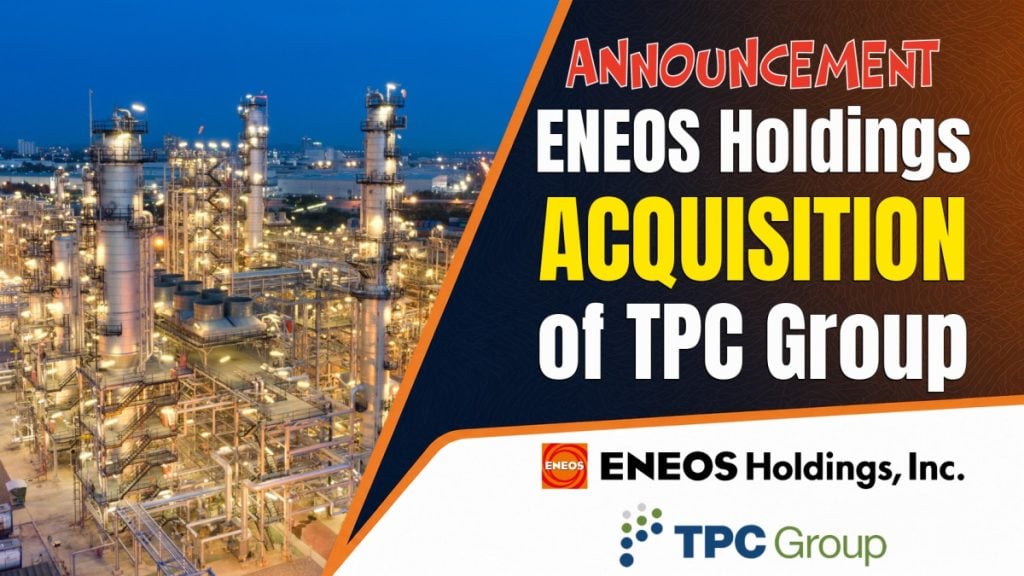
The transaction covers TPC Group’s Houston manufacturing operation and terminals in Port Neches and Lake Charles, with closing planned for October 2026 subject to regulatory approvals.
Published by Allstream Insiders.
Allstream Insiders Summary
ENEOS Holdings has entered into a definitive agreement to acquire TPC Holdings, the parent of TPC Group, adding a U.S. Gulf Coast C4 chemicals platform with manufacturing in Houston and terminal operations in Port Neches, Texas, and Lake Charles, Louisiana.
ENEOS expects the transaction to close in October 2026, subject to required regulatory approvals and other customary closing conditions. After completion, TPC will become a wholly owned ENEOS subsidiary within the company’s High Performance Materials segment.
TPC’s Houston operation occupies 256 acres near the Houston Ship Channel and has combined production capacity of more than 1.5 billion pounds per year, according to TPC. The site produces butadiene, butene-1, raffinate, isobutylene, diisobutylene and polyisobutylene. TPC also operates a 218-acre Port Neches terminal and a five-acre Lake Charles terminal that support C4 product storage and transportation.
ENEOS says that, after closing, the acquisition will give the group the world’s third-largest butadiene production capacity. The company has not disclosed the acquisition price, citing confidentiality obligations.
ENEOS-TPC Transaction Overview
| Item | Company-reported detail |
|---|---|
| Buyer | ENEOS Holdings, through a wholly owned U.S. subsidiary |
| Target | TPC Holdings, parent of TPC Group |
| Transaction status | Definitive merger agreement executed August 7, 2026 |
| Asset footprint | Houston petrochemical manufacturing; Port Neches, Texas, terminal; Lake Charles, Louisiana, terminal |
| Expected closing | October 2026, subject to regulatory approvals and other closing conditions |
| Post-closing ownership | TPC becomes a wholly owned ENEOS subsidiary in the High Performance Materials segment |
| Acquisition value | Not disclosed by ENEOS due to confidentiality obligations |
What Gulf Coast Assets Are Included in the Acquisition?
The acquisition brings TPC’s Houston C4 manufacturing operation and two Gulf Coast logistics terminals into the ENEOS portfolio. Together, the facilities connect crude C4 processing and derivative production with pipeline, marine, rail and storage infrastructure.
Houston Operations
TPC describes its Houston Operations site as its largest operating facility. The 256-acre complex near the Houston Ship Channel produces:
- Butadiene
- Butene-1
- Raffinate
- Isobutylene
- Diisobutylene
- Polyisobutylene
TPC lists combined production capacity at more than 1.5 billion pounds per year. In December 2024, the company said a completed crude C4 processing expansion increased the Houston site’s butadiene nameplate capacity to 1.1 billion pounds per year. The two figures describe different measures: the first covers combined site production capacity, while the second is specific to butadiene.
Port Neches Terminal
TPC’s 218-acre Port Neches terminal is located along the Sabine-Neches River. The company says the site moves crude C4, butadiene and raffinate through logistics infrastructure that includes pipeline, barge, rail and tank-car connections.
Lake Charles Terminal
TPC’s five-acre Lake Charles terminal includes a barge dock and storage-tank farm. The facility can offload butadiene from barges, store the product and move it by pipeline to customers.
Why Is ENEOS Acquiring TPC Group?
ENEOS is using the transaction to establish a larger North American C4 chemicals position and connect those operations with its existing materials businesses. C4 chemicals are products derived from four-carbon hydrocarbon streams, including butadiene, butenes and butanes.
Butadiene is an important feedstock for elastomers, including solution-polymerized styrene-butadiene rubber used in fuel-efficient tires. ENEOS said TPC holds leading North American positions across several C4 products, including butadiene, raffinate, 1-butene and polybutene.
The buyer plans to combine its operating experience with TPC’s U.S. platform and strengthen the supply chain from C4 chemicals to high-performance elastomers. ENEOS also identified access to shale gas-based feedstocks and U.S. materials demand as reasons for expanding in North America.
ENEOS’s statement that the combined group will hold the world’s third-largest butadiene production capacity is a company-reported ranking. Neither announcement provides the combined capacity figure or the methodology used to calculate that global position.
What Changes Before the Transaction Closes?
TPC Group and ENEOS will continue operating as separate companies until closing. TPC said it has no planned changes to day-to-day operations, customer commitments or supplier relationships in connection with the transaction.
TPC President and CEO Ed Dineen said, “With ENEOS, we will build on our strong foundation, support continued investment in our operations and further strengthen TPC Group’s position for long-term success.”
The announcement does not itself transfer ownership. Regulatory approvals and the other conditions in the merger agreement must be satisfied before TPC becomes part of ENEOS.
What Could the Acquisition Mean for Industrial Suppliers?
Allstream analysis: The transaction changes the ownership of an operating petrochemical and terminal platform; it is not an announcement of a new construction project or supplier award.
ENEOS and TPC both refer to continued investment and potential expansion in North America, but neither company identifies a new capital budget, named expansion, procurement schedule, contractor, equipment package or bid opportunity as part of the acquisition announcement.
If ENEOS later authorizes reliability, debottlenecking, storage, logistics or downstream integration projects at the acquired facilities, those programs could involve engineering, process equipment, rotating equipment, tanks, piping, valves, instrumentation, electrical systems, inspection, maintenance and terminal services. Any such scope remains contingent on future project-specific decisions and disclosures.
Allstream Perspective
The significance of the transaction is the combination of TPC’s operating C4 manufacturing and logistics network with ENEOS’s broader chemicals and high-performance materials strategy. The Houston site provides production scale near the Houston Ship Channel, while Port Neches and Lake Charles add multimodal terminal and storage capabilities along the Gulf Coast.
For the industrial market, the near-term milestone is the planned October 2026 closing and completion of the required regulatory process. Continued operations are expected during the review period. Future capital or supply-chain opportunities should be evaluated only when ENEOS or TPC identifies a specific project, approved budget, schedule or procurement action.