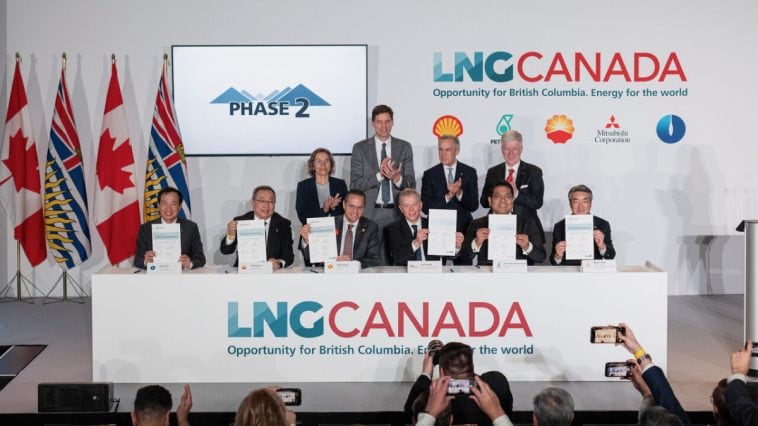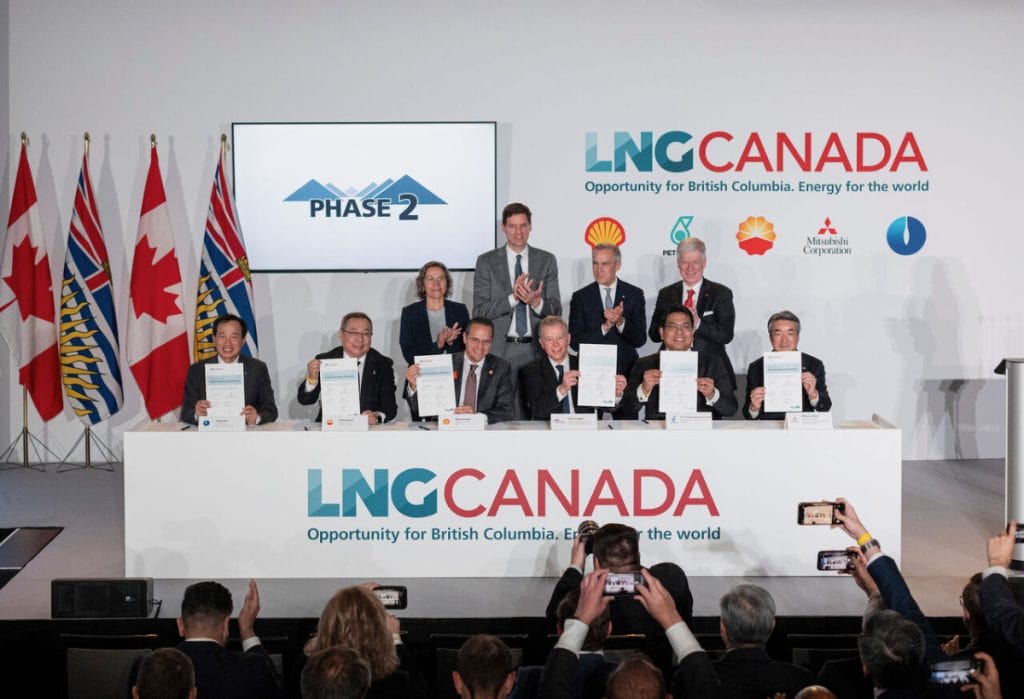
Shell Takes Final Investment Decision on LNG Canada Phase 2, Doubling Kitimat Capacity to 28 Mtpa
The expansion adds two LNG trains, new storage and loading infrastructure, and five Coastal GasLink compressor stations; commercial operations are expected in the early 2030s.
Published by Allstream Insiders
Allstream Insiders Summary
Shell Canada Energy, an affiliate of Shell plc, has taken a final investment decision on LNG Canada Phase 2, an expansion of the Kitimat, British Columbia facility that Shell said will increase total production capacity from 14 million tonnes per annum (mtpa) to 28 mtpa. Shell announced the decision on September 29, 2026.
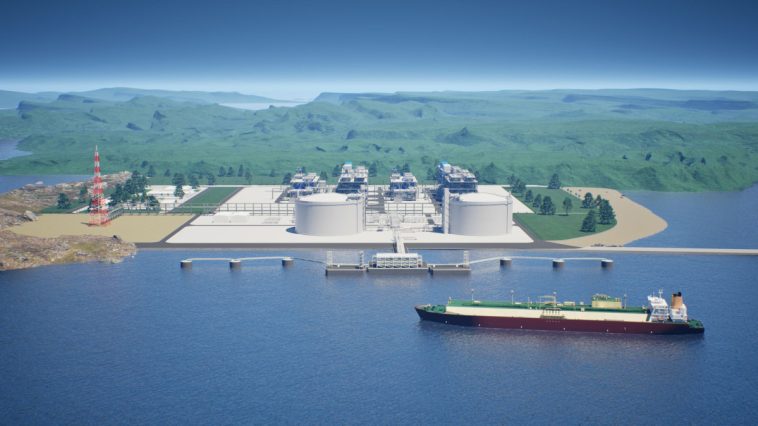
Phase 2 will add two LNG processing trains within the existing Kitimat facility, an additional LNG storage tank, a condensate tank, a loading berth, and expanded utility and process systems. Shell said Coastal GasLink will expand the capacity of its existing 670-kilometre pipeline through the construction of five new compressor stations. Commercial operations are expected to begin in the early 2030s.
What does LNG Canada Phase 2 include?
The final investment decision covers an expansion inside LNG Canada’s existing Kitimat facility. Shell said the new phase will add two LNG processing units, commonly called trains, bringing the facility’s stated production capacity to 28 mtpa.
The company also identified supporting infrastructure to be added at the facility: an LNG storage tank, a condensate tank, a loading berth, and expanded utility and process systems. Shell’s release does not identify the contractors, equipment suppliers, procurement packages, construction sequence or individual completion dates for those components.
| Disclosed item | Shell-reported detail |
|---|---|
| Project | LNG Canada Phase 2 |
| Location | Kitimat, British Columbia |
| Capacity before expansion | 14 mtpa |
| Capacity after expansion | 28 mtpa |
| New liquefaction capacity | Two LNG processing trains |
| Supporting facility additions | One LNG storage tank, one condensate tank, one loading berth, and expanded utility and process systems |
| Expected commercial operations | Early 2030s, according to Shell |
How will Coastal GasLink be expanded?
Shell said Coastal GasLink will expand the capacity of its existing 670-kilometre pipeline by constructing five new compressor stations. The release does not name the compressor-station locations, describe their individual horsepower or compression capacity, or disclose construction awards and work packages.
The pipeline expansion is part of the announced LNG Canada Phase 2 configuration, but Shell did not provide separate budgets or completion schedules for the Coastal GasLink work in this release.
What is Shell’s position in LNG Canada?
Shell holds a 40% interest in LNG Canada and said it will receive nearly 6 mtpa of additional LNG from the expansion. LNG Canada operates under an equity-lifting structure, meaning each joint-venture participant is responsible for taking its proportionate share of LNG production and arranging its corresponding gas supply.
Shell identified the other LNG Canada joint-venture participants as PETRONAS with a 25% interest, PetroChina Company Limited with 15%, Mitsubishi Corporation with 15%, and Korea Gas Corporation with 5%. LNG Canada Development Inc. operates the facility, according to Shell.
When is the expanded facility expected to begin commercial operations?
Shell expects commercial operations from LNG Canada Phase 2 to begin in the early 2030s. That is the company’s stated expectation, not a completed-service date. The release does not provide a year-specific startup target or train-by-train commissioning schedule.
Shell also did not disclose the project’s total capital cost, the financing structure, regulatory status for individual components or any construction start date in this announcement.
Allstream analysis: What the final investment decision establishes
Allstream analysis: The final investment decision moves a defined expansion into execution planning with a disclosed two-train configuration and associated terminal and pipeline-compression infrastructure. The announced additions show that Phase 2 involves more than liquefaction trains: the scope also includes storage, marine loading, utilities, process systems and additional upstream transportation compression.
However, Shell has not disclosed contractor selections, bid packages, equipment suppliers, project budgets or detailed construction timing. Those items should not be inferred from the final investment decision. For infrastructure-market participants, subsequent disclosures on engineering, procurement, construction, individual compressor-station locations and commissioning milestones will provide the clearest visibility into specific work scopes.